- LOGIN
- MemberShip
- 2026-06-15 18:08:04
- Mounjaro and Wegovy generate KRW 427 billion in 3 months
- by Chon, Seung-Hyun | translator Alice Kang | 2026-06-15 09:19:14
The new obesity treatments Mounjaro and Wegovy have taken over the Korean market. Mounjaro generated over KRW 323.2 billion in sales in just 3 months, while Wegovy surpassed KRW 100 billion in quarterly sales for the fourth consecutive quarter. Mounjaro patients showed a stronger demand for lower-dose products, whereas Wegovy patients recorded a higher share of high-dose prescriptions. Meanwhile, Saxenda, once the dominant obesity treatment, has seen its market influence decline dramatically.
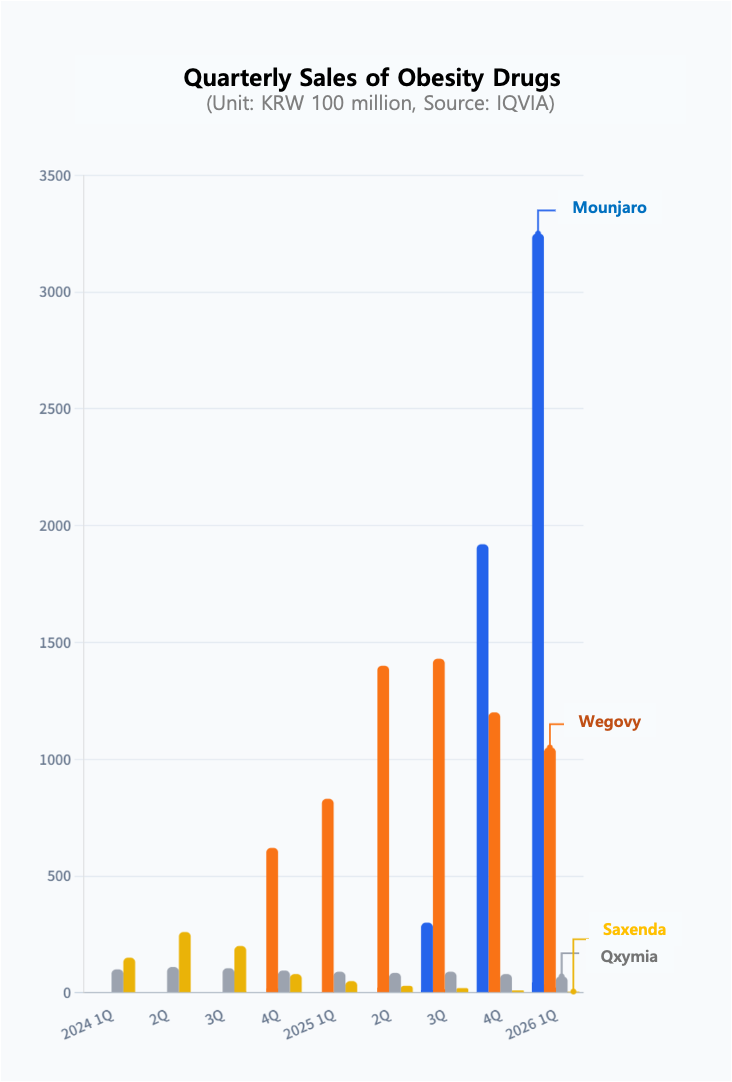
According to IQVIA data released on June 11, Eli Lilly's Mounjaro recorded KRW 323.2 billion in sales during the first quarter, making it the top-selling obesity treatment in Korea. This figure was more than three times higher than that of Wegovy, which was KRW 104 billion, firmly establishing Mounjaro as the market leader.
Mounjaro, which was released in Korea in August last year, is a dual agonist targeting both the glucose-dependent insulinotropic polypeptide (GIP) receptor and the glucagon-like peptide-1 (GLP-1) receptor. The drug lowers blood glucose levels before and after meals by stimulating insulin secretion, improving insulin resistance, and reducing glucagon secretion.
Mounjaro was first approved in Korea in June 2023 as a diabetes treatment. It was approved for the treatment of type 2 diabetes as an adjunct to diet and exercise for glycemic control. In August 2024, it gained an additional indication for chronic weight management in adults, to be used alongside a reduced-calorie diet and exercise regimen.
The drug generated its first sales of KRW 29.4 billion in the third quarter of last year and surged to KRW 191.6 billion in the fourth quarter, becoming the market leader in obesity treatment sales. Over the nine-month period from Q3 2025 through Q1 2026, cumulative sales reached KRW 544.1 billion, rapidly reshaping the obesity treatment landscape.
Mounjaro has also overtaken Wegovy and risen to the lead in the global obesity drug market. Last year, Mounjaro recorded worldwide sales of USD 23.07 billion (approximately KRW 33 trillion), significantly exceeding Wegovy's sales of DKK 79.1 billion (approximately KRW 18 trillion).
Industry analysis shows that obese patients in Korea have an increased demand for Mounjaro due to its superior weight-loss efficacy.
GLP-1 suppresses appetite by stimulating satiety centers in the brain and slows gastric emptying. GIP not only enhances insulin secretion but also promotes fat metabolism and synergistically helps reduce gastrointestinal side effects commonly associated with GLP-1 therapies.
Mounjaro demonstrated significant weight-loss benefits in the Phase 3 SURMOUNT-1 trial involving overweight adults without diabetes who had a BMI of at least 30 kg/m² or at least one weight-related comorbidity. In the trial, patients receiving Mounjaro experienced an average weight reduction exceeding 15% at Week 72, while those receiving the highest dose achieved weight loss of approximately 21% of body weight.
Mounjaro also outperformed Wegovy in the head-to-head SURMOUNT-5 study.
Results showed that patients receiving Mounjaro (10 mg or 15 mg) achieved an average weight reduction of 20.2% at Week 72, compared with 13.7% among patients receiving Wegovy (1.7 mg or 2.4 mg).
Novo Nordisk's Wegovy may have lost its leadership position, but it continues to post quarterly sales exceeding KRW 100 billion.
Wegovy generated KRW 104 billion in Q1 sales, representing a 26.6% increase from the same period a year earlier. The drug contains semaglutide, a GLP-1 receptor agonist. Novo Nordisk developed Wegovy after observing substantial weight-loss effects during clinical trials of GLP-1-based diabetes treatments.
Following its launch in Korea in October 2024, Wegovy quickly became a commercial success. The drug generated KRW 62.3 billion in sales during the fourth quarter of 2024 and immediately became the market leader in obesity treatment sales.
By Q2 2025, Wegovy had achieved KRW 138.5 billion in quarterly sales, surpassing the KRW 100 billion milestone within just nine months of launch. It has now maintained quarterly sales above KRW 100 billion for four consecutive quarters. Even before entering Korea, Wegovy gained global notoriety as a weight-loss aid favored by celebrities, contributing to worldwide supply shortages. Novo Nordisk strengthened its commercial presence by signing a co-promotion agreement with Chong Kun Dang in September last year.
However, Wegovy's sales have declined for two consecutive quarters since peaking at KRW 142 billion in Q3 last year. Analysts attribute the slowdown to competition from Mounjaro and the impact of price reductions. After Mounjaro entered the Korean market in August last year, Wegovy reduced its supply price by approximately 40%. Since Q4 2024, Wegovy has generated cumulative sales of KRW 649.6 billion over an 18-month period. Combined cumulative sales of Mounjaro and Wegovy have now exceeded KRW 1 trillion.
Mounjaro and Wegovy showed contrasting prescribing patterns by dose strength. Mounjaro had higher sales volumes in lower dosages, while Wegovy had a higher market share in higher-dosage products.
Mounjaro is currently sold in four different strengths: 2.5mg, 5mg, 7.5mg, and 10mg. In the first quarter, a total of 3,868,149 units were sold, with 5mg and 2.5mg being the most popular, at 1,551,910 units and 1,474,823 units, respectively. The market shares for 5mg and 2.5mg were 40% and 38%, respectively, accounting for a total of 78%. In comparison, the higher-dose 7.5 mg and 10 mg products accounted for only 12% and 10% of Wegovy’s sales, respectively.
Wegovy is approved in five strengths: 0.25 mg, 0.5 mg, 1 mg, 1.7 mg, and 2.4 mg. Each pen contains enough medication for four administrations. For instance, the 0.25mg product contains a total of 1mg, which can be administered four times using a single pen. In the first quarter, the 2.4mg dosage held the highest sales volume share at 34%, followed by 1mg at 22% and 1.7mg at 15%. The lowest dosage, 0.25mg, had the smallest share at 12%.
It is analyzed that Mounjaro has a high share of low-dosage products intended for initial treatment due to its relatively late entry into the domestic market, whereas Wegovy, having been on the market for over a year, has a higher proportion of patients in follow-up treatment stages.
Some industry observers suggest that the growing trend of ‘dose splitting’ with Wegovy may be contributing to the strong preference for higher-dose products. Unlike Mounjaro, which is supplied as a single-use prefilled pen, Wegovy is a multi-dose injection pen that allows users to select and adjust the dose before administration. As a result, many patients reportedly receive higher-dose prescriptions and divide them into multiple lower-dose injections. In fact, supply shortages have risen for Wegovy's higher-dose products. The proportion of the 2.4 mg dose among total Wegovy sales volume increased 15 percentage points from 19% in the first quarter of last year.
The market positions of Saxenda and Qsymia, which dominated the obesity treatment market before the emergence of Wegovy, have shrunk significantly.
Novo Nordisk's Saxenda generated only KRW 900 million in first-quarter sales. Before the launch of Wegovy, Saxenda recorded KRW 15.1 billion in first-quarter sales in 2024, but more than 90% of that revenue disappeared within 2 years. Launched in Korea in 2018, Saxenda was the world's first obesity treatment approved as a GLP-1 analogue. It contains the same active ingredient, liraglutide, as the diabetes treatment Victoza, differing only in dosage and administration. Following its launch, Saxenda became the leading obesity treatment in Korea, recording KRW 42.6 billion in sales in 2019 and maintaining the top position for five consecutive years through 2023. However, the introduction of Wegovy and Mounjaro has reduced its market presence to a minimal level. Industry observers believe that Wegovy, another GLP-1-based therapy, has effectively absorbed most of Saxenda's market.
Meanwhile, Alvogen Korea's Qsymia posted KRW 7.1 billion in first-quarter sales, down 18.5% year-on-year. Launched in Korea at the end of 2019, Qsymia is a fixed-dose combination product containing phentermine and topiramate.’ Alvogen Korea acquired the domestic marketing rights from U.S.-based Vivus in 2017. Although Qsymia experienced a smaller sales decline than Saxenda, it remains far behind Wegovy and Mounjaro. Combined first-quarter sales of Saxenda and Qsymia totaled just KRW 7.9 billion, representing less than 2% of the combined KRW 427.2 billion generated by the newer obesity treatments Wegovy and Mounjaro during the same period.
-

- 0
댓글 운영방식은
댓글은 실명게재와 익명게재 방식이 있으며, 실명은 이름과 아이디가 노출됩니다. 익명은 필명으로 등록 가능하며, 대댓글은 익명으로 등록 가능합니다.
댓글 노출방식은
댓글 명예자문위원(팜-코니언-필기모양 아이콘)으로 위촉된 데일리팜 회원의 댓글은 ‘게시판형 보기’와 ’펼쳐보기형’ 리스트에서 항상 최상단에 노출됩니다. 새로운 댓글을 올리는 일반회원은 ‘게시판형’과 ‘펼쳐보기형’ 모두 팜코니언 회원이 쓴 댓글의 하단에 실시간 노출됩니다.
댓글의 삭제 기준은
다음의 경우 사전 통보없이 삭제하고 아이디 이용정지 또는 영구 가입제한이 될 수도 있습니다.
-
저작권·인격권 등 타인의 권리를 침해하는 경우
상용 프로그램의 등록과 게재, 배포를 안내하는 게시물
타인 또는 제3자의 저작권 및 기타 권리를 침해한 내용을 담은 게시물
-
근거 없는 비방·명예를 훼손하는 게시물
특정 이용자 및 개인에 대한 인신 공격적인 내용의 글 및 직접적인 욕설이 사용된 경우
특정 지역 및 종교간의 감정대립을 조장하는 내용
사실 확인이 안된 소문을 유포 시키는 경우
욕설과 비어, 속어를 담은 내용
정당법 및 공직선거법, 관계 법령에 저촉되는 경우(선관위 요청 시 즉시 삭제)
특정 지역이나 단체를 비하하는 경우
특정인의 명예를 훼손하여 해당인이 삭제를 요청하는 경우
특정인의 개인정보(주민등록번호, 전화, 상세주소 등)를 무단으로 게시하는 경우
타인의 ID 혹은 닉네임을 도용하는 경우
-
게시판 특성상 제한되는 내용
서비스 주제와 맞지 않는 내용의 글을 게재한 경우
동일 내용의 연속 게재 및 여러 기사에 중복 게재한 경우
부분적으로 변경하여 반복 게재하는 경우도 포함
제목과 관련 없는 내용의 게시물, 제목과 본문이 무관한 경우
돈벌기 및 직·간접 상업적 목적의 내용이 포함된 게시물
게시물 읽기 유도 등을 위해 내용과 무관한 제목을 사용한 경우
-
수사기관 등의 공식적인 요청이 있는 경우
-
기타사항
각 서비스의 필요성에 따라 미리 공지한 경우
기타 법률에 저촉되는 정보 게재를 목적으로 할 경우
기타 원만한 운영을 위해 운영자가 필요하다고 판단되는 내용
-
사실 관계 확인 후 삭제
저작권자로부터 허락받지 않은 내용을 무단 게재, 복제, 배포하는 경우
타인의 초상권을 침해하거나 개인정보를 유출하는 경우
당사에 제공한 이용자의 정보가 허위인 경우 (타인의 ID, 비밀번호 도용 등)
※이상의 내용중 일부 사항에 적용될 경우 이용약관 및 관련 법률에 의해 제재를 받으실 수도 있으며, 민·형사상 처벌을 받을 수도 있습니다.
※위에 명시되지 않은 내용이더라도 불법적인 내용으로 판단되거나 데일리팜 서비스에 바람직하지 않다고 판단되는 경우는 선 조치 이후 본 관리 기준을 수정 공시하겠습니다.
※기타 문의 사항은 데일리팜 운영자에게 연락주십시오. 메일 주소는 dailypharm@dailypharm.com입니다.