- LOGIN
- MemberShip
- 2026-09-15 07:21:17
- Drug pricing re-evaluation lawsuit reverses the situation
- by Kim, Jin-Gu | translator Hong, Ji Yeon | 2026-04-07 07:22:47
The lawsuit Medica Korea filed to cancel the price reductions on its existing drugs, challenging the government's re-evaluation of maximum prices, has concluded in the pharmaceutical company's favor. This ruling is expected to have a significant impact beyond the relief to an individual company, influencing the implementation of future government drug price reduction measures.
In particular, the significance of this ruling has grown as the government announced a reform plan last month that strengthens the drug price reduction rate from the current 15% to 20% when generic standard requirements are not met. Analysis suggests that pharmaceutical companies facing price cuts due to administrative delays now have a clear justification for pursuing legal action.
3-Year Legal Battle Concludes... A Litigation Started by 'Re-evaluation of Listed Drugs'
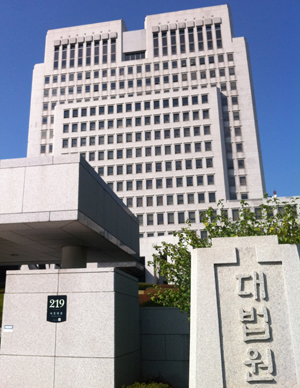
The origin of this case was the "Generic drug price system reform" implemented in July 2020. The government decided to apply differential drug prices based on whether two standard requirements were met: ▲ conducting independent bioequivalence tests and ▲ using registered drug master files (DMF). Additionally, the government conducted a re-evaluation by applying these standards to drugs already listed on the reimbursement list.
In September 2023, following the re-evaluation, the Ministry of Health and Welfare (MOHW) announced a price reduction for five items, including Medica Korea's 'Telmisartan Tab,' citing noncompliance with standard requirements.
Medica Korea responded immediately by filing a lawsuit to cancel the disposition and an application for a stay of execution. Both the first and second-instance courts ruled in favor of the pharmaceutical company. Subsequently, on the 2nd, the Supreme Court finalized the original verdict by dismissing the government's appeal through a "discontinuation of proceedings." The three-year legal dispute ended in a complete victory for the pharmaceutical company. This is considered unusual, given that cases in which pharmaceutical companies win drug price lawsuits against the government have been very rare.
“Violation of Administrative Procedures + Abuse of Discretion”... The Court Highlights Three Illegalities in the Government's Measure
According to the Article 8(2) issued by the Seoul High Court's ruling, confirmed by the Supreme Court, the court found that the MOHW's disposition not only violated administrative procedural principles but also constituted a deviation and abuse of discretionary power.
◆“Administration Cannot Change Its Word” = The court pointed out the "unauthorized change of grounds for disposition" applied by the government to some items. The MOHW initially issued a price reduction for Medica Korea's five items because they failed to meet 'Standard Requirement 1' (independent bioequivalence testing). However, during the lawsuit, they argued that the items also failed to meet 'Standard Requirement 2' (the use of a registered DMF).
Regarding this, the court stated that it is unacceptable to present separate facts that lack identity with the original grounds at the time of disposition. This is interpreted as a reaffirmation of the principle that the executive branch must not infringe upon a party's right to defense by arbitrarily changing the basis for a disposition.
◆“Substantial Fulfillment is More Important Than Paperwork” = The court ruled that 'substantial fulfillment of requirements' should take precedence over the 'formal completeness of documents.' Medica Korea was unable to submit the final "DMF Change Authorization Certificate" within the government-set deadline. However, they had already submitted an 'Application for change authorization' before this, clearly indicating their intent to use registered drug master files. Despite this, the government issued the price reduction citing 'failure to submit documents within the deadline.'
The court judged that “submitting the authorization certificate is merely one means of proving fulfillment, not the sole evidentiary material,” and that “if a pharmaceutical company has made its best efforts, it should be recognized.”
◆A Warning Against ‘Administrative Convenience’ = The court clarified that the situation where the Ministry of Food and Drug Safety's (MFDS) review was delayed due to an explosion of change authorization applications following the drug price reform 'cannot be viewed as the responsibility of the plaintiff (pharmaceutical company).'
The court ruled that it is unreasonable to hold a company responsible for document-submission delays caused by external factors beyond its control, to reduce drug prices. This is interpreted as a court warning against the government's drug price reductions driven by administrative convenience.
Will 'Second Medica' Cases Follow Amid Concerns of Recurring ‘Administrative Bottlenecks’?
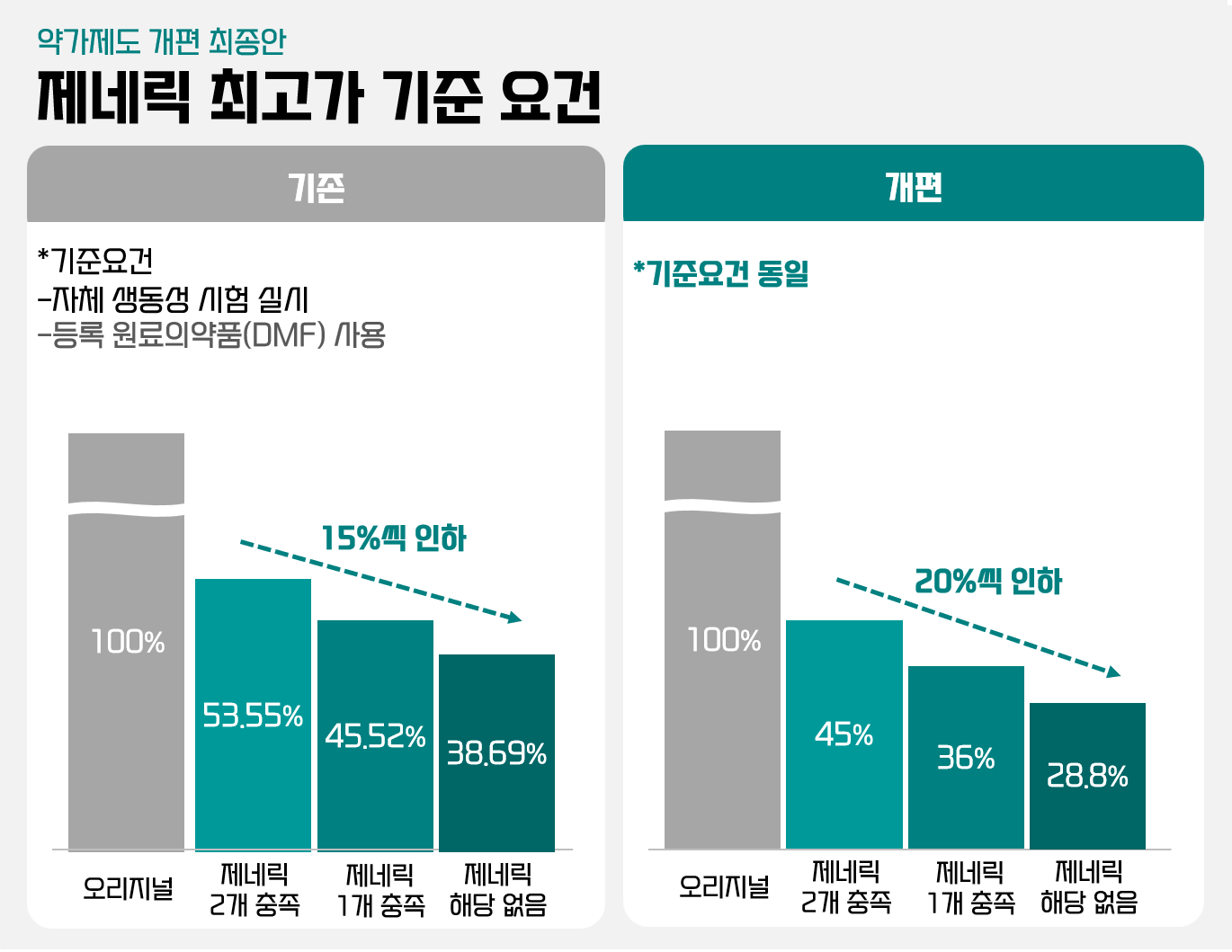
This ruling is expected to have a greater ripple effect, as it coincides with the government's last month's drug-pricing reform plan. Under the reform, the basic calculation rate for generic drug prices will be reduced from 53.55% to 45%. Concurrently, the reduction rate for failing to meet standard requirements will be raised from 15% to 20%.
Under the existing system, if one standard requirement was not met, the generic drug price was applied at 45.52% (53.55 x 0.85); if two were not met, at 38.69% (45.52 x 0.85). Under the new system, it will drop significantly to 36.00% (45.00 x 0.8) for one failure and 28.8% (36.00 x 0.8) for two failures.
These standards also apply to already-listed generics. Industry concerns are that the chaos of 2023 will repeat itself. In September 2023, the government simultaneously lowered the prices of 7,355 items. This was a measure that applied the drug price system, reformed in 2020, to existing items en masse. However, during the large-scale price reduction process, delays in data submission and review bottlenecks occurred, leading to continuous confusion and administrative conflicts regarding the interpretation of standards.
The Medica Korea lawsuit is also analyzed to have occurred against this backdrop. Analysts believe that, in the process of evaluating and disposing of numerous items in a short period, the government failed to adequately review individual cases, leading to 'formalistic judgments' taking precedence.
There is a possibility that even more listed items will be subject to price reductions in this reform. In this case, the administrative burden on the government will inevitably increase. It is noted that this process could create a vicious cycle of administrative errors, leading to more lawsuits.
Reduction Rate Increased from 15% to 20%... Potential for Mass Recurrence of ‘Defensive Bioequivalence’ Tests
The measures taken by the pharmaceutical industry for 'price defense' are also factors fueling market confusion. Specifically, there is a high possibility that so-called 'defensive bioequivalence' tests to meet standard requirements will flood the market again.
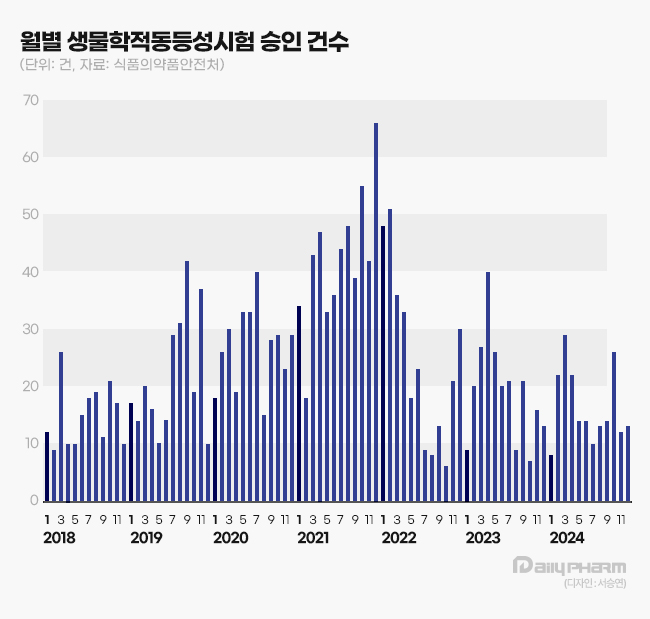
After the 2020 system reform, pharmaceutical companies rushed to conduct bioequivalence tests to defend prices. Companies developed generics themselves through internal formulation research and then conducted bioequivalence tests. Based on the equivalence results, they adopted a strategy of shifting from outsourced to in-house manufacturing to meet the 'conducting bioequivalence tests' requirement and maintain drug prices. In fact, the annual number of bioequivalence test approvals, which was 178 in 2018, surged to 323 in 2020 and 505 in 2021.
The cost per bioequivalence test is estimated at KRW 300-500 million. Criticisms have been raised that spending hundreds of millions of won on bioequivalence tests to maintain drug prices, when the drugs are already being sold without issue after the government has recognized their safety and efficacy, is a waste of resources. Nevertheless, because the scale of price reductions has increased, the structure forces companies to increase additional bioequivalence tests to prevent losses.
"Litigation is Profitable"... The 'Learning Effect' Presented by the Medica Korea Precedent
Concerns are rising in the pharmaceutical industry that the litigation wars that followed the simultaneous reduction of 7,300 items in September 2023 will be repeated.
With the Supreme Court's ruling now established, pharmaceutical companies' response is expected to become more aggressive. From a company's perspective, rather than accepting a 20% reduction, it is a rational choice to file a lawsuit to cancel the price reduction and seek a stay of execution under the Medica Korea precedent. Voices are high that unnecessary litigation will proliferate socially.
Consequently, the government has a significant administrative burden during the large-scale drug price adjustment process. Following this Supreme Court ruling, the government's mechanical administrative convenience will find it difficult to gain legal legitimacy. Moving forward, the government faces the task of establishing flexible administrative guidelines that take into account realistic factors, such as the MFDS's review status, rather than insisting solely on the 'formal completeness of documents' during the price adjustment process for listed generics.
A pharmaceutical industry official stated, "This ruling clearly established that substantial efforts by companies should not be ignored for administrative convenience. This case is expected to serve as an important legal reference for pharmaceutical companies to respond to the government's administration in the upcoming large-scale drug price reductions."
-

- 0
댓글 운영방식은
댓글은 실명게재와 익명게재 방식이 있으며, 실명은 이름과 아이디가 노출됩니다. 익명은 필명으로 등록 가능하며, 대댓글은 익명으로 등록 가능합니다.
댓글 노출방식은
댓글 명예자문위원(팜-코니언-필기모양 아이콘)으로 위촉된 데일리팜 회원의 댓글은 ‘게시판형 보기’와 ’펼쳐보기형’ 리스트에서 항상 최상단에 노출됩니다. 새로운 댓글을 올리는 일반회원은 ‘게시판형’과 ‘펼쳐보기형’ 모두 팜코니언 회원이 쓴 댓글의 하단에 실시간 노출됩니다.
댓글의 삭제 기준은
다음의 경우 사전 통보없이 삭제하고 아이디 이용정지 또는 영구 가입제한이 될 수도 있습니다.
-
저작권·인격권 등 타인의 권리를 침해하는 경우
상용 프로그램의 등록과 게재, 배포를 안내하는 게시물
타인 또는 제3자의 저작권 및 기타 권리를 침해한 내용을 담은 게시물
-
근거 없는 비방·명예를 훼손하는 게시물
특정 이용자 및 개인에 대한 인신 공격적인 내용의 글 및 직접적인 욕설이 사용된 경우
특정 지역 및 종교간의 감정대립을 조장하는 내용
사실 확인이 안된 소문을 유포 시키는 경우
욕설과 비어, 속어를 담은 내용
정당법 및 공직선거법, 관계 법령에 저촉되는 경우(선관위 요청 시 즉시 삭제)
특정 지역이나 단체를 비하하는 경우
특정인의 명예를 훼손하여 해당인이 삭제를 요청하는 경우
특정인의 개인정보(주민등록번호, 전화, 상세주소 등)를 무단으로 게시하는 경우
타인의 ID 혹은 닉네임을 도용하는 경우
-
게시판 특성상 제한되는 내용
서비스 주제와 맞지 않는 내용의 글을 게재한 경우
동일 내용의 연속 게재 및 여러 기사에 중복 게재한 경우
부분적으로 변경하여 반복 게재하는 경우도 포함
제목과 관련 없는 내용의 게시물, 제목과 본문이 무관한 경우
돈벌기 및 직·간접 상업적 목적의 내용이 포함된 게시물
게시물 읽기 유도 등을 위해 내용과 무관한 제목을 사용한 경우
-
수사기관 등의 공식적인 요청이 있는 경우
-
기타사항
각 서비스의 필요성에 따라 미리 공지한 경우
기타 법률에 저촉되는 정보 게재를 목적으로 할 경우
기타 원만한 운영을 위해 운영자가 필요하다고 판단되는 내용
-
사실 관계 확인 후 삭제
저작권자로부터 허락받지 않은 내용을 무단 게재, 복제, 배포하는 경우
타인의 초상권을 침해하거나 개인정보를 유출하는 경우
당사에 제공한 이용자의 정보가 허위인 경우 (타인의 ID, 비밀번호 도용 등)
※이상의 내용중 일부 사항에 적용될 경우 이용약관 및 관련 법률에 의해 제재를 받으실 수도 있으며, 민·형사상 처벌을 받을 수도 있습니다.
※위에 명시되지 않은 내용이더라도 불법적인 내용으로 판단되거나 데일리팜 서비스에 바람직하지 않다고 판단되는 경우는 선 조치 이후 본 관리 기준을 수정 공시하겠습니다.
※기타 문의 사항은 데일리팜 운영자에게 연락주십시오. 메일 주소는 dailypharm@dailypharm.com입니다.