- LOGIN
- MemberShip
- 2026-10-09 20:29:57
- Drug price cuts push pharma to tighten workforce spending
- by Lee, Seok-Jun | translator Alice Kang | 2026-10-08 09:00:37
Drug price cuts are beginning to take a toll on pharmaceutical employment. Faced with mounting pressure on profitability, companies are scaling back new hiring and leaving positions vacated through natural attrition unfilled, while tightening performance management and overhauling compensation and pay structures. What began as a one-time “workforce expense diet” is increasingly becoming a permanent approach to labor-cost management.
Under the drug pricing reform implemented in August, the maximum pricing rate for off-patent drugs and generics was lowered from 53.55% to 45%. The government has decided to apply the new standard to previously listed drugs as well, with prices for 13,958 products in the first reassessment round set to be adjusted from next April.
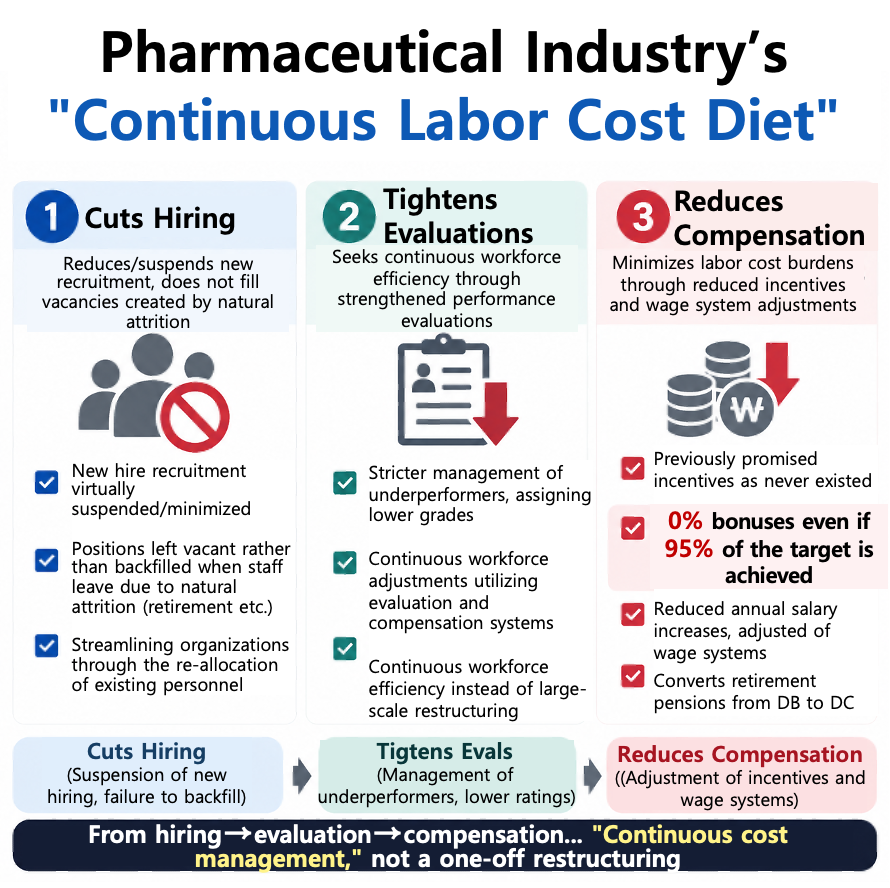
According to industry sources, some pharmaceutical companies have recently all but suspended entry-level recruitment or reduced hiring to a minimum. Companies are also leaving positions vacated through retirement and other natural attrition unfilled, instead redeploying existing employees.
Rather than resorting to large-scale restructuring, companies are managing overall labor costs by restricting recruitment and not replacing departing employees. The trend is seen as an effort to reduce fixed costs as the risk of declining profitability from drug price cuts increases.
Performance management of existing employees is also becoming more stringent. Industry sources say some companies are grading employees on scales such as A through D and subjecting those receiving lower ratings to closer management. Repeated low ratings can also have the effect of inducing voluntary retirement among employees, according to industry officials.
The approach allows companies to gradually adjust workforce levels through performance evaluation and compensation systems rather than sharply reducing headcount through short-term restructuring. For employers, it offers a way to pursue continued workforce efficiency while reducing the burden associated with formal restructuring.
Standards for incentive payments are also becoming tighter. In some cases, bonuses that had initially been expected have been eliminated, while employees who achieve as much as 95% of their targets receive no incentive if they fail to meet the 100% threshold.
In other words, coming close to a target may no longer be enough to earn a reward. Cost controls are expanding beyond recruitment and headcount to compensation for existing employees.
Wages are no exception. As pressure on earnings and profitability grows, companies may respond by limiting salary increases or revising their wage structures. The focus of cost management is thus broadening from the number of employees to the cost of each individual employee.
Retirement plans are also emerging as a means of cost management. According to industry sources, some pharmaceutical companies have begun encouraging employees to switch from defined benefit (DB) retirement plans to defined contribution (DC) plans.
Under a DB plan, the employee’s retirement benefit is determined in advance, with the employer responsible for managing the plan assets and paying the benefit. Under a DC plan, the employer pays a predetermined annual contribution into the employee’s account, while the eventual retirement benefit varies according to investment performance. From the employer’s perspective, a DC plan can make long-term retirement benefit obligations relatively easier to forecast and manage.
However, because wage structures and retirement plan arrangements differ from company to company, a shift from DB to DC plans cannot necessarily be characterized as a direct cost-saving response to drug price cuts. It is more appropriately viewed as one of several changes occurring at some companies as they seek to manage labor costs and long-term financial obligations.
Cutting ‘spending on people’...prolonged trend could weigh on competitiveness
Changes in pharmaceutical workforce management illustrate where the cost burden from lower drug prices may ultimately be transferred. Lower prices may benefit patients and National Health Insurance finances, but pharmaceutical companies facing reduced profitability inevitably begin reviewing their internal costs.
Labor is one of the most readily adjustable cost categories. What begins with reduced recruitment and unfilled vacancies is now extending to performance evaluations, incentives, wages, and retirement plans.
The concern is what happens if the trend persists. A prolonged decline in entry-level recruitment could slow generational turnover within organizations. Repeated workforce adjustments and increasingly stringent performance management could also affect job security and employee engagement.
The impact could be greater still if investment in core pharmaceutical personnel, including R&D and sales staff, is reduced. Efforts to protect profitability from drug price cuts could lead to lower investment in personnel, which in turn could weaken companies’ R&D and sales competitiveness.
An industry official said, “When profitability declines because of drug price cuts, costs are ultimately the first thing companies tend to control. Practices such as reducing new hiring, leaving vacancies from natural attrition unfilled and improving the efficiency of the existing workforce will likely continue.”
The official added, “The impact of drug price cuts does not end with drug prices. If reduced hiring, tighter performance management, workforce redeployment and changes to compensation and wage structures continue, it means pharmaceutical companies have begun reassessing even how much they spend on their people in order to protect profitability.”
-

- 0
댓글 운영방식은
댓글은 실명게재와 익명게재 방식이 있으며, 실명은 이름과 아이디가 노출됩니다. 익명은 필명으로 등록 가능하며, 대댓글은 익명으로 등록 가능합니다.
댓글 노출방식은
댓글 명예자문위원(팜-코니언-필기모양 아이콘)으로 위촉된 데일리팜 회원의 댓글은 ‘게시판형 보기’와 ’펼쳐보기형’ 리스트에서 항상 최상단에 노출됩니다. 새로운 댓글을 올리는 일반회원은 ‘게시판형’과 ‘펼쳐보기형’ 모두 팜코니언 회원이 쓴 댓글의 하단에 실시간 노출됩니다.
댓글의 삭제 기준은
다음의 경우 사전 통보없이 삭제하고 아이디 이용정지 또는 영구 가입제한이 될 수도 있습니다.
-
저작권·인격권 등 타인의 권리를 침해하는 경우
상용 프로그램의 등록과 게재, 배포를 안내하는 게시물
타인 또는 제3자의 저작권 및 기타 권리를 침해한 내용을 담은 게시물
-
근거 없는 비방·명예를 훼손하는 게시물
특정 이용자 및 개인에 대한 인신 공격적인 내용의 글 및 직접적인 욕설이 사용된 경우
특정 지역 및 종교간의 감정대립을 조장하는 내용
사실 확인이 안된 소문을 유포 시키는 경우
욕설과 비어, 속어를 담은 내용
정당법 및 공직선거법, 관계 법령에 저촉되는 경우(선관위 요청 시 즉시 삭제)
특정 지역이나 단체를 비하하는 경우
특정인의 명예를 훼손하여 해당인이 삭제를 요청하는 경우
특정인의 개인정보(주민등록번호, 전화, 상세주소 등)를 무단으로 게시하는 경우
타인의 ID 혹은 닉네임을 도용하는 경우
-
게시판 특성상 제한되는 내용
서비스 주제와 맞지 않는 내용의 글을 게재한 경우
동일 내용의 연속 게재 및 여러 기사에 중복 게재한 경우
부분적으로 변경하여 반복 게재하는 경우도 포함
제목과 관련 없는 내용의 게시물, 제목과 본문이 무관한 경우
돈벌기 및 직·간접 상업적 목적의 내용이 포함된 게시물
게시물 읽기 유도 등을 위해 내용과 무관한 제목을 사용한 경우
-
수사기관 등의 공식적인 요청이 있는 경우
-
기타사항
각 서비스의 필요성에 따라 미리 공지한 경우
기타 법률에 저촉되는 정보 게재를 목적으로 할 경우
기타 원만한 운영을 위해 운영자가 필요하다고 판단되는 내용
-
사실 관계 확인 후 삭제
저작권자로부터 허락받지 않은 내용을 무단 게재, 복제, 배포하는 경우
타인의 초상권을 침해하거나 개인정보를 유출하는 경우
당사에 제공한 이용자의 정보가 허위인 경우 (타인의 ID, 비밀번호 도용 등)
※이상의 내용중 일부 사항에 적용될 경우 이용약관 및 관련 법률에 의해 제재를 받으실 수도 있으며, 민·형사상 처벌을 받을 수도 있습니다.
※위에 명시되지 않은 내용이더라도 불법적인 내용으로 판단되거나 데일리팜 서비스에 바람직하지 않다고 판단되는 경우는 선 조치 이후 본 관리 기준을 수정 공시하겠습니다.
※기타 문의 사항은 데일리팜 운영자에게 연락주십시오. 메일 주소는 dailypharm@dailypharm.com입니다.
- [Reporter’s View] Rebate investigation expertise must survive system overhaul
- Reporter's view | Kim, Jin-Gu

- Entresto patent upheld in US, invalidated in Korea…Approval the next hurdle
- Reporter's view | Kim, Jin-Gu
-

- "Besremi garners attention as a long-term treatment option for PV"
- Professor Dae-young Kim of the Department of Hematology-Oncology at CHA Bundang Medical Center