- LOGIN
- MemberShip
- 2026-06-23 14:26:28
- Domestic DMFs lose ground despite pricing incentives
- by Kim, Jin-Gu | translator Alice Kang | 2026-06-23 09:52:37
Despite the government's efforts to encourage the use of domestically produced active pharmaceutical ingredients (APIs) through pricing incentives, the pharmaceutical industry remains largely unconvinced.
The number of domestic Drug Master File (DMF) registrations in the first half of this year remained at a level similar to last year and fell below the half-year average recorded over the past 5 years, prompting criticism that more practical and effective policies are needed to promote API localization.
According to the Ministry of Food and Drug Safety (MFDS) on June 22, a total of 434 new DMFs had been registered as of June 19 this year. Of those, only 22 were registered by companies located in South Korea. The figure includes only fully domestic APIs, for which the entire manufacturing process, from starting materials and intermediates to the final API, was carried out within Korea.
This is similar to the 22 registrations recorded in the first half of last year and the 21 registrations in the second half of last year. However, compared with the average of 28.3 registrations per half-year over the past 5 years since the first half of 2021, the number has actually declined by 6 cases. Compared with 41 registrations recorded in each half of 2021, when the COVID-19 pandemic fueled calls for greater self-reliance of APIs, the current level is nearly half.
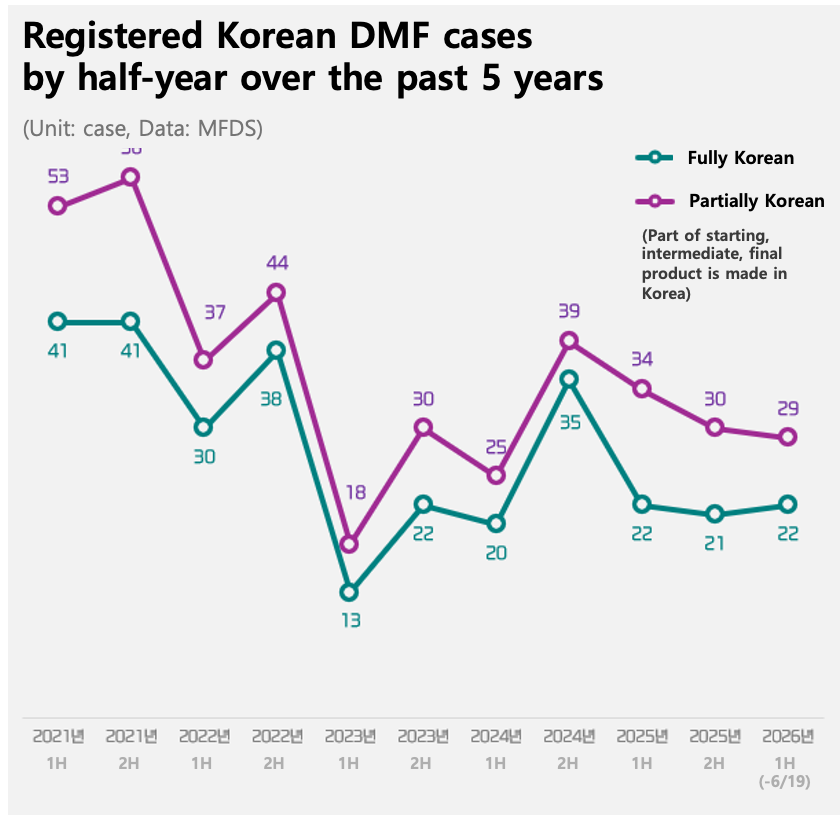
The downward trend remains evident even when the scope is broadened to include partially domestic DMFs, in which at least one stage, from material, intermediate, to final API, is manufactured in Korea. The number of partially domestic DMFs in the first half of this year was 29, down 5 cases from 34 during the same period last year and about 6 below the 5-year half-year average of 36.6.
When considering how the Ministry of Health and Welfare announced a pricing premium ‘up to 10 years’ under its pharmaceutical pricing reform for drugs using domestic APIs, this decline has drawn criticism that the system has little practical effect.
The government had pledged substantial pricing incentives for products considered strategically important for strengthening domestic API self-sufficiency. While generic drug pricing rates are set to fall from 53.55% to 45% of the original drug’s price, premiums equivalent to 68% will be granted to ▲ supply-stabilization medicines produced using self-manufactured APIs, ▲national essential medicines using domestic APIs, and ▲ self-manufactured injectable antibiotics and pediatric medicines.
Previously, such incentives applied only to newly listed products, but the revised policy will also apply retroactively to already listed products. For both essential medicines produced using domestic raw materials and those that utilize locally sourced API, the basic 10-year preferential pricing period will continue if additional requirements are met and the supply remains limited to three or fewer companies.
Despite the prospect of reimbursement incentives lasting more than a decade, industry response has been lukewarm. Industry observers note that the government's pricing premium is insufficient to offset the overwhelming manufacturing cost gap compared with when using Chinese and Indian APIs.
In fact, registrations of Chinese and Indian APIs surged to the second-highest level on record during the first half of this year.
Of the 434 DMFs registered during the period, 381 originated from China or India, accounting for approximately 88% of the total. This is the second highest over the past 5 years, following a 90% share in the first half of last year. Chinese and Indian DMFs accounted for roughly 60% of registrations until 2022, exceeded 70% in 2023, and surpassed 80% in the first half of last year.
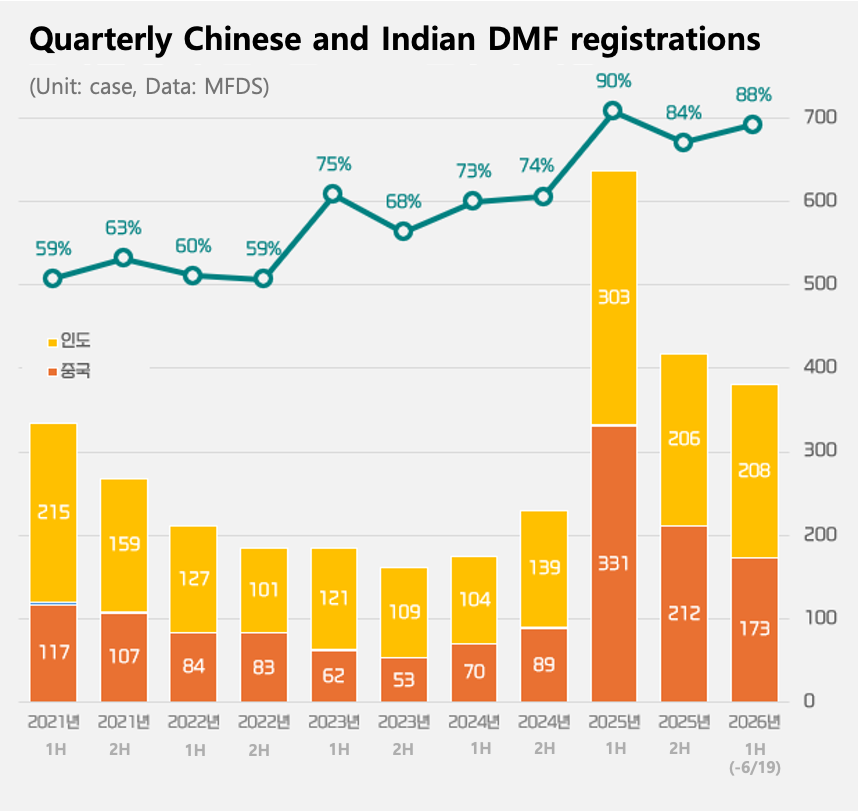
Meanwhile, API supply diversification has deteriorated significantly. The share of APIs sourced from regions outside Korea, China, and India, such as North America, Europe, and Japan, had exceeded 30% as recently as the first half of 2022. However, the figure has steadily declined and now stands at just 7% in the first half of this year.
An industry official criticized, “Considering labor costs, raw material procurement expenses, and environmental compliance costs, the production cost of domestic APIs is uncompetitive compared to those from China and India. The modest premium proposed by the government is nowhere near enough to provide pharmaceutical companies with an economic incentive to shift away from their existing China- and India-based API supply chains.”
The official added, “The pricing reform still lacks clear subordinate regulations or guidelines regarding how the origin of starting materials and intermediates will be recognized. As a result, there is considerable confusion in the industry over exactly how much localization is required in order to qualify for preferential pricing.”
-

- 0
댓글 운영방식은
댓글은 실명게재와 익명게재 방식이 있으며, 실명은 이름과 아이디가 노출됩니다. 익명은 필명으로 등록 가능하며, 대댓글은 익명으로 등록 가능합니다.
댓글 노출방식은
댓글 명예자문위원(팜-코니언-필기모양 아이콘)으로 위촉된 데일리팜 회원의 댓글은 ‘게시판형 보기’와 ’펼쳐보기형’ 리스트에서 항상 최상단에 노출됩니다. 새로운 댓글을 올리는 일반회원은 ‘게시판형’과 ‘펼쳐보기형’ 모두 팜코니언 회원이 쓴 댓글의 하단에 실시간 노출됩니다.
댓글의 삭제 기준은
다음의 경우 사전 통보없이 삭제하고 아이디 이용정지 또는 영구 가입제한이 될 수도 있습니다.
-
저작권·인격권 등 타인의 권리를 침해하는 경우
상용 프로그램의 등록과 게재, 배포를 안내하는 게시물
타인 또는 제3자의 저작권 및 기타 권리를 침해한 내용을 담은 게시물
-
근거 없는 비방·명예를 훼손하는 게시물
특정 이용자 및 개인에 대한 인신 공격적인 내용의 글 및 직접적인 욕설이 사용된 경우
특정 지역 및 종교간의 감정대립을 조장하는 내용
사실 확인이 안된 소문을 유포 시키는 경우
욕설과 비어, 속어를 담은 내용
정당법 및 공직선거법, 관계 법령에 저촉되는 경우(선관위 요청 시 즉시 삭제)
특정 지역이나 단체를 비하하는 경우
특정인의 명예를 훼손하여 해당인이 삭제를 요청하는 경우
특정인의 개인정보(주민등록번호, 전화, 상세주소 등)를 무단으로 게시하는 경우
타인의 ID 혹은 닉네임을 도용하는 경우
-
게시판 특성상 제한되는 내용
서비스 주제와 맞지 않는 내용의 글을 게재한 경우
동일 내용의 연속 게재 및 여러 기사에 중복 게재한 경우
부분적으로 변경하여 반복 게재하는 경우도 포함
제목과 관련 없는 내용의 게시물, 제목과 본문이 무관한 경우
돈벌기 및 직·간접 상업적 목적의 내용이 포함된 게시물
게시물 읽기 유도 등을 위해 내용과 무관한 제목을 사용한 경우
-
수사기관 등의 공식적인 요청이 있는 경우
-
기타사항
각 서비스의 필요성에 따라 미리 공지한 경우
기타 법률에 저촉되는 정보 게재를 목적으로 할 경우
기타 원만한 운영을 위해 운영자가 필요하다고 판단되는 내용
-
사실 관계 확인 후 삭제
저작권자로부터 허락받지 않은 내용을 무단 게재, 복제, 배포하는 경우
타인의 초상권을 침해하거나 개인정보를 유출하는 경우
당사에 제공한 이용자의 정보가 허위인 경우 (타인의 ID, 비밀번호 도용 등)
※이상의 내용중 일부 사항에 적용될 경우 이용약관 및 관련 법률에 의해 제재를 받으실 수도 있으며, 민·형사상 처벌을 받을 수도 있습니다.
※위에 명시되지 않은 내용이더라도 불법적인 내용으로 판단되거나 데일리팜 서비스에 바람직하지 않다고 판단되는 경우는 선 조치 이후 본 관리 기준을 수정 공시하겠습니다.
※기타 문의 사항은 데일리팜 운영자에게 연락주십시오. 메일 주소는 dailypharm@dailypharm.com입니다.
- "Cosentyx is shifting the treatment paradigm for hidradenitis suppurativa"
- Reporter's view | Son, Hyung Min

- [Reporter's View] Will Nth National Bio Innovation Committee yield any results?
- Reporter's view | Kim, Jin-Gu