- LOGIN
- MemberShip
- 2026-09-14 22:50:48
- ‘Forcing 40% generic drug price cut will kill the industry’
- by Lee, Jeong-Hwan | translator Alice Kang | 2026-03-05 17:30:40
“If the generic price calculation rate is cut to 40%, companies will inevitably halt new drug research and development (R&D). Also, they will also stop producing medicines that are not profitable, even if they are designated as essential medicines or market-withdrawal prevention drugs. Companies will likely proceed with workforce restructuring to remove what they see as unnecessary personnel, which will worsen employment instability. While the pharmaceutical industry understands the government’s goal of strengthening the sustainability of the national health insurance system, , the absolute limit we can accept is 48%. Even lowering the current rate of 53.55% by more than 5 percentage points will cause considerable management losses and shock.”
Although the MOHW has decided to postpone the implementation of its drug pricing system reform plan that focuses on generic drug price cuts and preferential pricing for innovative pharmaceutical companies until next year, the pharmaceutical industry has emphasized the need for revisions, stating that ‘the details matter more than the timing.’
Multiple pharmaceutical companies have criticized the MOHW's proposed reform plan, arguing it fails to create a structure that properly values companies that have consistently invested in producing high-quality medicines, improving R&D capabilities for incrementally modified drugs and new drugs, and contributing to the stable supply of pharmaceuticals.
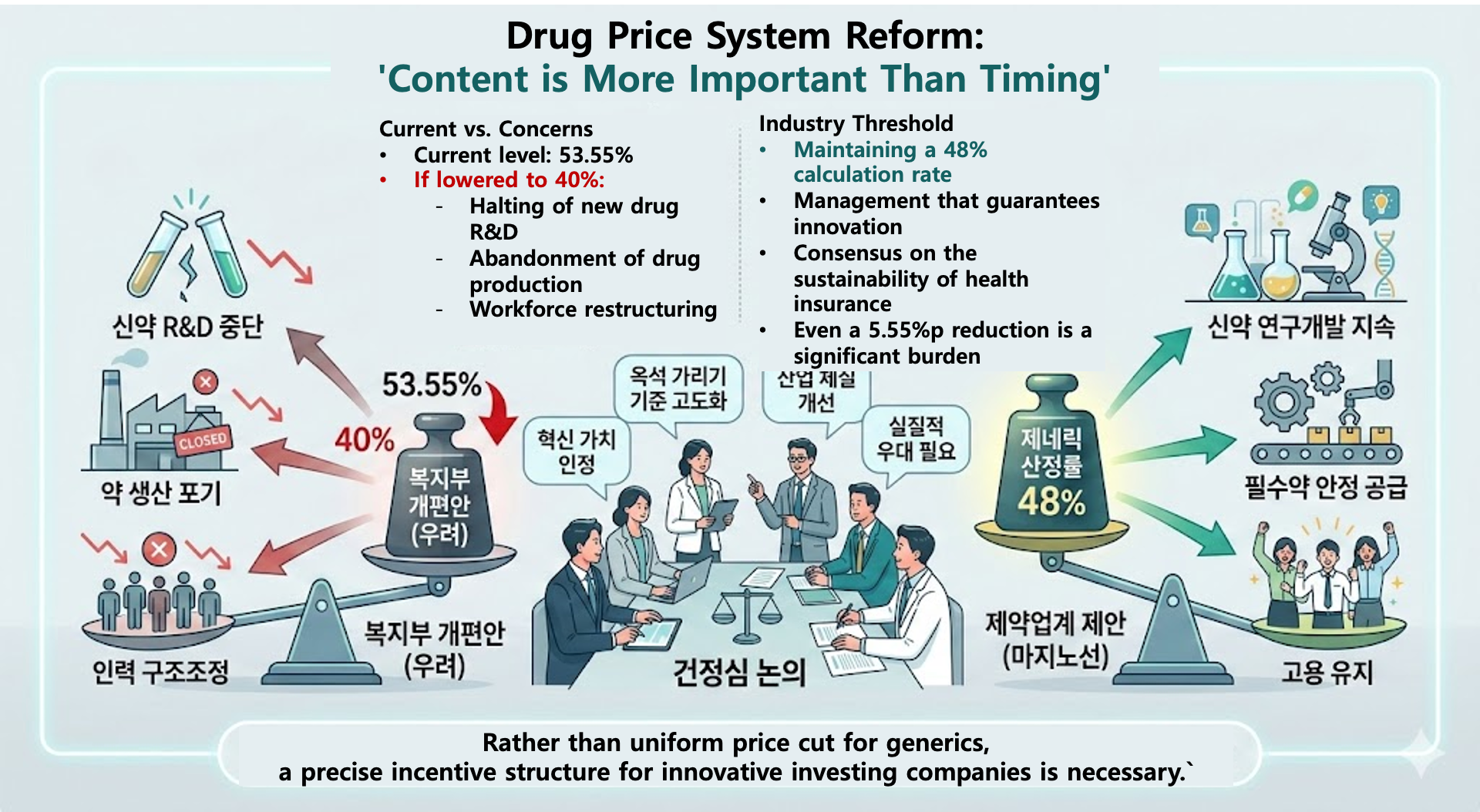
In particular, while the industry understands the government’s intention to reduce drug prices to cut healthcare spending, many companies suggest that the maximum acceptable generic pricing rate would be 48%.
This represents a 5.55 percentage point reduction from the current 53.55% calculation rate, equivalent to a roughly 10% drug price reduction when the generic calculation price is set at 100. The intent is to indicate that, while maintaining current operations and accepting the MOHW's policy, they can only tolerate a price reduction level of up to 10% when calculating the administrative shock impact on sales revenue and other factors.
On the 4th, pricing managers at domestic pharmaceutical companies did not offer particularly positive assessments upon hearing that the MOHW is considering delaying the implementation of the drug pricing system reform plan until January next year.
This is because, even looking at the implementation plan for the drug pricing system reform announced on November 28 last year, it was foreseeable that the timing for major policy implementations, such as drug price reductions, would be next year.
Industry officials say that the specific details of the reform to be finalized at this month’s Health Insurance Policy Deliberation Committee (HIPDC) are far more important than the implementation schedule.
The industry criticizes that the reform plan confirmed by the HIPDC must include measures that can fundamentally improve the domestic pharmaceutical industry's structure. They argue that the drug price preferential criteria and generic drug price reduction methods proposed by the MOHW thus far are essentially irrelevant to pharmaceutical industry innovation.
Companies also say the government must significantly refine the criteria and tools used to evaluate a pharmaceutical company’s “innovation.”
They argue that simply ranking companies based on whether they are certified as an “innovative pharmaceutical company or their R&D expenditure ratio relative to sales revenue to grant preferential drug pricing, or uniformly lowering generic drug prices, fails to accurately gauge the value of each company's true level of innovation.
Pharmaceutical companies propose that the MOHW must establish and implement a drug pricing system reform plan that employs a multi-layered innovation assessment tool. They argue this would naturally lead to the elimination of ‘paper companies’ that contribute little to the development and innovation of the domestic pharmaceutical industry, while favoring drug prices for companies that diligently pursue value-based investment and sound management. This, they contend, would achieve the goal of pharmaceutical industry innovation.
Furthermore, observations of advanced countries indicate that lowering the generic drug pricing rate to 40% may trigger the abandonment of domestic pharmaceutical production.
Analyzing the cases of Japan and France, where the generic drug pricing levels are 40-50%, similar to the level proposed by the MOHW, Japan saw supply shortages and production discontinuation of 4,064 items (23.1% of generic items). Even in the French case published by the European Medicines Agency (EMA), only 15% of new generics are produced in France, and only 30% of all generic drugs are produced in the country.
Given these precedents, the industry strongly advocates 48% as the maximum acceptable generic pricing rate, representing a 5.55 percentage-point reduction from the current 53.55% rate, but still significantly higher than the ministry’s proposed level in the 40% range.
A representative from domestic pharmaceutical company A stated, “Contrary to the policy goal of prioritizing innovation value in the pharmaceutical industry, the MOHW's drug pricing system adopts a blanket price reduction approach. This structure means that companies with larger sales volumes and greater investment scale will incur proportionally larger absolute losses. A revised proposal must be developed to ensure that pharmaceutical companies that have contributed to the industry's development through clinical trial achievements, expansion of high-quality drug manufacturing facilities, advanced quality control, and hiring research personnel can gain a clear competitive advantage over paper companies.”
Another official from pharmaceutical company B said, “If the government truly wants to build an innovative ecosystem for the pharmaceutical industry and strengthen health security, it must create clear criteria to identify companies that genuinely contribute to those goals and provide appropriate pricing incentives. If the generic pricing rate is reduced to the 40% range, this would cause immediate operational losses for pharmaceutical companies, creating shockwaves severe enough to prevent them from fulfilling new drug development, stable supply of essential medicines, and maintaining employment. Maintaining a minimum calculation rate of 48% is essential to ensure management is capable of sustaining innovation.”
-

- 0
댓글 운영방식은
댓글은 실명게재와 익명게재 방식이 있으며, 실명은 이름과 아이디가 노출됩니다. 익명은 필명으로 등록 가능하며, 대댓글은 익명으로 등록 가능합니다.
댓글 노출방식은
댓글 명예자문위원(팜-코니언-필기모양 아이콘)으로 위촉된 데일리팜 회원의 댓글은 ‘게시판형 보기’와 ’펼쳐보기형’ 리스트에서 항상 최상단에 노출됩니다. 새로운 댓글을 올리는 일반회원은 ‘게시판형’과 ‘펼쳐보기형’ 모두 팜코니언 회원이 쓴 댓글의 하단에 실시간 노출됩니다.
댓글의 삭제 기준은
다음의 경우 사전 통보없이 삭제하고 아이디 이용정지 또는 영구 가입제한이 될 수도 있습니다.
-
저작권·인격권 등 타인의 권리를 침해하는 경우
상용 프로그램의 등록과 게재, 배포를 안내하는 게시물
타인 또는 제3자의 저작권 및 기타 권리를 침해한 내용을 담은 게시물
-
근거 없는 비방·명예를 훼손하는 게시물
특정 이용자 및 개인에 대한 인신 공격적인 내용의 글 및 직접적인 욕설이 사용된 경우
특정 지역 및 종교간의 감정대립을 조장하는 내용
사실 확인이 안된 소문을 유포 시키는 경우
욕설과 비어, 속어를 담은 내용
정당법 및 공직선거법, 관계 법령에 저촉되는 경우(선관위 요청 시 즉시 삭제)
특정 지역이나 단체를 비하하는 경우
특정인의 명예를 훼손하여 해당인이 삭제를 요청하는 경우
특정인의 개인정보(주민등록번호, 전화, 상세주소 등)를 무단으로 게시하는 경우
타인의 ID 혹은 닉네임을 도용하는 경우
-
게시판 특성상 제한되는 내용
서비스 주제와 맞지 않는 내용의 글을 게재한 경우
동일 내용의 연속 게재 및 여러 기사에 중복 게재한 경우
부분적으로 변경하여 반복 게재하는 경우도 포함
제목과 관련 없는 내용의 게시물, 제목과 본문이 무관한 경우
돈벌기 및 직·간접 상업적 목적의 내용이 포함된 게시물
게시물 읽기 유도 등을 위해 내용과 무관한 제목을 사용한 경우
-
수사기관 등의 공식적인 요청이 있는 경우
-
기타사항
각 서비스의 필요성에 따라 미리 공지한 경우
기타 법률에 저촉되는 정보 게재를 목적으로 할 경우
기타 원만한 운영을 위해 운영자가 필요하다고 판단되는 내용
-
사실 관계 확인 후 삭제
저작권자로부터 허락받지 않은 내용을 무단 게재, 복제, 배포하는 경우
타인의 초상권을 침해하거나 개인정보를 유출하는 경우
당사에 제공한 이용자의 정보가 허위인 경우 (타인의 ID, 비밀번호 도용 등)
※이상의 내용중 일부 사항에 적용될 경우 이용약관 및 관련 법률에 의해 제재를 받으실 수도 있으며, 민·형사상 처벌을 받을 수도 있습니다.
※위에 명시되지 않은 내용이더라도 불법적인 내용으로 판단되거나 데일리팜 서비스에 바람직하지 않다고 판단되는 경우는 선 조치 이후 본 관리 기준을 수정 공시하겠습니다.
※기타 문의 사항은 데일리팜 운영자에게 연락주십시오. 메일 주소는 dailypharm@dailypharm.com입니다.