
- LOGIN
- MemberShip
- 2026-05-14 07:00:47
- Company
- 2022 Pharmaceutical Industry Advertising Target Call Members
- by Dec 14, 2022 05:56am
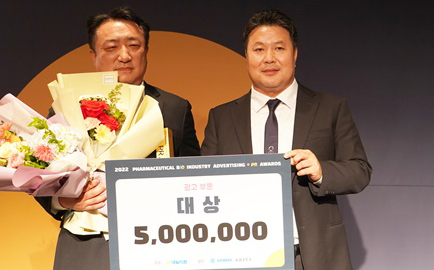
- Dailypharm held the 2022 Pharmaceutical Bio Industry Advertising PR Awards on the 7th. Representative Lee Jung-seok (6th from left) and the winnersDaewon Pharmaceutical's "Coldewon" and Sanofi's "Honey Jam Market for Those Who Can't Sleep" won the grand prize in the advertising and PR categories at the 2022 Korea Pharmaceutical Bio-Industry Advertising and PR Awards. Chong Kun Dang Benfobell won the grand prize in the "Special Award for Pharmacist Selection" category, which was decided by the votes of pharmacists. Dailypharm (CEO Lee Jung-seok) held an award ceremony for the 2022 Korea Pharmaceutical Bio-Industry Advertising and PR Awards at the Diamond Hall of InterContinental Seoul COEX Hotel on the 7th. More than 200 advertising and public relations officials from domestic and foreign pharmaceutical bio companies, including Won Hee-mok and Lee Young-shin, vice chairman of KRPIA, attended the event. At the ceremony, which marks its 10th anniversary this year, a total of 72 works were submitted in five categories, including TV, printing and radio, the Internet, and PR. More than 200 advertising and PR workers from the pharmaceutical bio-industry attended the event The awards were divided into advertising and PR categories. The advertising sector was divided into two categories: TV, Internet, and radio. The grand prize in each field and three excellence awards were selected along with the grand prize. In the PR category, the grand prize, one grand prize, and three excellence awards were honored. A special award was also given to 1,300 pharmacists who voted directly. Daewon Pharmaceutical's Coldewon won the grand prize in this year's advertising category. The award-winning work was awarded a prize of 5 million won along with the trophy. Yoo Seong-kwon, director of Daewon Pharmaceutical, said, "This year seems to have been a year when Coldewon received a lot of attention and took a leap forward. I am grateful that I received that energy and received a good award, he said. "I will try to stand here next year with good advertisements for new items." In the TV category, Shinshin Pharmaceutical's Arex was selected as the best prize, and a prize of 3 million won was given along with the trophy. ▲ Sanofi Allegra, ▲ Ildong Pharmaceutical's Aronamin C Plus Tab, and ▲ Limited's Mag-B Speed Excellence Award. The excellence award was awarded a trophy and a prize of 2 million won. In the Internet/radio category, HKinno.N's "Condition" won the grand prize. ▲Houns Radio Corporate Advertising ▲ Johnson & Johnson Nicorette ▲ JW Pharmaceutical 'Himom bands' were selected for the Excellence Awards. The award-winning film was given a trophy and prize money. In the PR sector, there were many entries that threw meaningful messages, including social contribution activities. This year's PR category was won by Sanofi's campaign to improve awareness of atopic dermatitis diseases, Honey Jam Market for those who can't sleep. The award-winning work was awarded a prize of 5 million won along with the trophy. Kim Hyun-jung, director of Sanofi Specialty Care, said, "We have been campaigning to improve awareness of atopic dermatitis diseases for four years since 2019. This year, the "Honey Jam Market for People Who Can't Sleep" was held to form a consensus on the physical and mental pain of patients. It is an honor that the patient's sincerity has paid off with a good award. "I will continue to make efforts to hold various campaigns for patients," he said. Yoo Seong-kwon, director of Daewon Pharmaceutical (left), and Lee Jung-seok, CEO of Daily Farm, who won the Grand Prize in advertising Dongkuk Pharmaceutical's "pupil earthquake" campaign was selected as the best prize in the PR category. ▲Ginexin, the god of memory (SK Chemical) ▲Growup Bio-Up Campaign (Amgen Korea) ▲YYPharm, including blood donation of love, won the Excellence Award. In the special prize category selected by online voting of 1,300 pharmacists, Chong Kun Dang was selected as the Benfobell target and won a trophy and 5 million won in prize money. Lee Sang-soo, deputy director of Chong Kun Dang, said, "Since the launch of Benfobell, it has been loved by pharmacists so far. It has a special meaning because pharmacists voted for it themselves. I think it's thanks to your consistent communication with us. "I'll be Benfobell who works harder." Donghwa Pharmaceutical Itchi won the grand prize in the special award for pharmacist selection. ▲Master Pharmaceutical Mayqueen ▲ Dong-A Pharmaceutical Panpyrin and others received the Excellence Award. Ahn Dae-cheon, former chairman of the Korea Advertising Association (Professor of Inha University), was the judge, while Chung Jae-hoon, a professor at Chonbuk National University, and Lee Jae-guk, executive director of the Korea Pharmaceutical Bio Association, participated as professional judges. Ahn, chairman of the judging committee, said, "The review of the advertising sector was based on whether the message was well matched and clearly delivered, secondly on the novelty of the idea, and thirdly on the reliability of the information. The PR division considered whether it could contribute to enhancing its image from a long-term perspective and whether messages and activities could elicit timely and consumer sympathy, he said. "We praise your efforts to develop advertising and promotion in the pharmaceutical bio industry." The Korea Pharmaceutical Bio-Industry Advertising and PR Awards began in 2013 with the aim of encouraging advertising promoters who give new values to the pharmaceutical industry and drugs and encouraging pharmacists, who are primarily advertising consumers, to produce advertisements that form a consensus. Lee Jung-seok, CEO of dailypharm, said in a greeting, "Many excellent works have been submitted this year, so I would like to thank pharmaceutical bio officials. I would like to congratulate you on your award-winning work. "We will make it a more fruitful and beneficial event next year," he said. Sanofi Specialty Care Director Kim Hyun-jung and CEO Lee Jung-seok, who won the PR category grand prize Chairman Won Hee-mok then said, "In the age of aging, the category of health management and prevention along with treatment has expanded, and the proportion of OTC drugs is increasing. At the same time, as the subject of the information is digitally transferred to consumers, changes are taking place in general drug advertisements, he said. "I hope it will be a place to find a new paradigm of general drug advertisements." "Thank you to Daily Farm for planning the advertising and PR targets," he said. Vice Chairman Lee Young-shin said, "With the development of artificial intelligence and digital healthcare, it has become an era of understanding the development of science and technology in the global beyond Korea. Advertising and promotion of drugs is no exception, he said. "I would like to thank advertising and public relations officials and media officials who have recognized new changes and delivered more accurate information in the regulated healthcare industry and contributed to improving the quality of life of the people." "KRPIA will also make efforts to grow with the domestic pharmaceutical bio industry."
- Policy
- $25.5 billion in exports to the health industry
- by Kim, Jung-Ju Dec 14, 2022 05:56am
- Exports of health medicine-related industries this year amounted to $25.5 billion, similar to last year, but the export of medicines such as biosimilars and vaccines was notable. The pharmaceutical sector is expected to surpass $10 billion for the first time next year based on a single item, raising expectations as a next-generation "good son export sector." The Health Industry Promotion Agency (Acting Director Kim Young-ok) announced the "2022 Major Export Performance and 2023 Export Forecast" this afternoon (7th). Although it recorded the highest performance in the first half of the year* thanks to increased demand for COVID-19 vaccines, treatments, and diagnostic products, the decline in quarantine goods (vaccines and diagnostic products) was noticeable due to full-scale enddemicization in the second half. Looking at export trends in the first half of 2022, it grew by 8.5% to a total of $13.35 billion, of which pharmaceuticals increased by 45% to $4.35 billion. Medical devices grew 5.2% to $4.93 billion, and cosmetics fell 11.9% to $4.06 billion. In particular, exports of medicines are expected to increase by 23.9% year-on-year due to biopharmaceuticals (biosimilars) and vaccines, but exports of medical devices and cosmetics are expected to decrease by 7.3% and 10.1% due to the full-fledged COVID-19 endemic and worsening external conditions. This year, the average monthly export of the health industry was $20.8 billion, continuing positive growth for 33 months since September 2019, and turning to negative growth since June this year. By industry, pharmaceutical exports are expected to rise 15.5% year-on-year to $10.1 billion, cosmetics are expected to rise 6.7% to $8.8 billion, and medical devices are expected to fall 6.2%, to $8 billion. Exports by region are expected to grow 5.8 percent to $13.6 billion, Europe to $6.8 billion, and North America to $4.2 billion, with Asia/Pacific exports expected to account for more than half. Diagnostic products, which had increased exports due to the global pandemic, are expected to continue to decline in exports, and exports of anti-pathogenic biological drugs such as biosimilars and toxins will continue to increase, accounting for 23.8% of the market share (based on division). Among them, pharmaceutical exports are expected to surpass $10 billion next year, up 15.5% from this year, based on the first single item ever. Exports of vaccines and treatments, which have soared since the end of last year, are expected to gradually decrease, and overall exports of medicines are expected to grow steadily due to continued demand for biosimilars. In the case of medical devices, exports are expected to fall 6.2% from this year to $8 billion next year. Existing major items such as ultrasound imaging devices, implants, and radiographic devices are expected to exceed exports in 2019, before COVID-19, thanks to a rapid recovery. On the other hand, exports of reagents for diagnosis in Korea are expected to gradually decrease as demand for COVID-19-related products decreases worldwide. Han Dong-woo, head of the Health Industry Innovation Planning Division at the Promotion Agency, said, "In 2023, health industry exports are expected to increase 5.4 percent year-on-year to $26.9 billion as cosmetics exports turn positive along with steady exports of medicines." "Since COVID-19, our health industry has proven its growth potential due to rapid increases in exports, but it may be more sensitive to external shocks such as weak economic conditions, global supply chain instability, high export dependence on the U.S. and China, and policies to strengthen protectionism," Han said. Meanwhile, the agency explained that it is working to support the industry and support government policies by providing information on exports and imports in the health industry, investigating overseas perceptions of the health industry, analyzing the impact of supply chain reorganization, and collecting opinions from the industry.
- Company
- Prolia's annual sales are expected to be 100 billion won
- by Kim, Jin-Gu Dec 14, 2022 05:56am
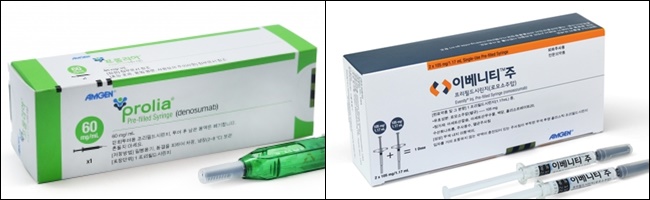
- Prolia & Evenity Amgen's Prolia, which dominated the osteoporosis treatment market, is further strengthening its dominance system. Sales are expected to surpass 100 billion won by the end of this year. Evenity, a generic for Prolia, is also rapidly increasing its sales. It has grown into the second-largest product in the osteoporosis treatment market in less than two years since the salary was applied in December 2020. According to IQVIA, a pharmaceutical market research firm, Prolia's cumulative sales in the third quarter of this year were 83.8 billion won. It increased by 28.6% compared to the same period last year-on-year. Prolia is a mechanism drug that inhibits bone absorption. It has become the first standard treatment for osteoporosis due to its superior effectiveness and convenience of administration compared to BP, which has been widely used in the past. It is difficult to take BP for patients, such as taking a sufficient amount of water on an empty stomach 1 to 2 hours before a meal and not lying down for at least 30 minutes after taking it. It was difficult for patients to continue to take medicine because side effects such as gastrointestinal disorders may occur when taking it for a long time. Prolia only needs to be administered once every six months. Even after 10 years of long-term treatment, the effect of continuous bone density improvement and consistent safety profile were confirmed. Prolia's beneifit was applied only to the secondary treatment in 2017. From April 2019, the range of benefits has been expanded to primary treatments. Sales rose vertically shortly after the benefit increase. Prolia's sales, which stood at only 14.3 billion won in 2018, more than tripled in a year to 47.3 billion won in 2019. It has been steadily increasing to 75.1 billion won in 2020 and 92.1 billion won in 2021. This year, sales of more than 80 billion won in the third quarter are expected to surpass 100 billion won at the end of the year. During this period, Prolia's price was reduced by 17.6% on three occasions. The drug price, which was 215,678 won at the time of initial registration, fell to 190,000 won in April 2019, 177,650 won in December 2020 and 168,800 won in July this year. As usage soared, drug prices were lowered by PVA. Considering the reduction in drug prices, it is possible to estimate that Prolia's use at the prescription site has increased significantly than sales growth. It is analyzed that the expansion of benefits and the strengthening of sales power also contributed to Prolia's growth. Amgen has been selling Prolia with Chong Kun Dang since September 2017. Amgen Korea is in charge of sales and marketing of Prolia at hospitals and Chong Kun Dang at clinics. Evenity's rise, released as Prolia's generic, is steeper. The cumulative sales in the third quarter of this year were 12.2 billio wonn, up 47.4% from the cumulative 8.3 billion won in the third quarter of last year. Evenity is a bone formation agent with a dual effect of promoting bone formation and inhibiting bone absorption.Amgen is devising Evenity's positioning strategy as sequential administration from Evenity to Prolia . Evenity, which was granted in June 2019, was registered in December 2020. Even before the registration, the drug received great attention at the prescription site. It generated 3.8 billion won in sales in 2020. It has been growing more rapidly since the benefit registration. In 2021, sales more than tripled in a year to 12.3 billion won. Until the third quarter of this year, sales were almost the same as last year. It is expected to record sales of more than 15 billion won at the end of the year. As Amgen's two products made strides, sales of existing BP formulations were low. Eli Lilly Forsteo's cumulative sales in the third quarter of this year were 9.7 billion won. It remains at the same level as last year. The cumulative sales of Hanmi Pharmaceutical's RaboneD in the third quarter decreased by 1.5% from 7.4 billion won last year to 7.3 billion won this year. The rest of the products have a bigger drop in sales. Daewoong Zoledronic Acid saw its sales fall 33.6% from 7.8 billion won to 5.2 billion won during the period. Jeil's Bonviva and Bonviva Plus fell 21.3% from 8.1 billion won to 6.4 billion won. Since October, Jeil has taken over the domestic rights of Bonviva and Bonviva Plus from Handok. Handok has been in charge of Bonviva's domestic sales and marketing for the past seven years.
- Company
- Baxter ranks first in the 70 billion hemostatic market
- by Nho, Byung Chul Dec 13, 2022 06:07am
- In the 70 billion won-shaped hemostatic market, Baxter Floseal is likely to surpass 30 billion won in sales this year, and is expected to rank first for the third consecutive year. According to the drug distribution performance data, Baxter Flossal's sales reached 25.3 billion won and Hyundai Pharmaceutical's Tachosil's sales reached 12.5 billion won until the third quarter of this year, ranking first and second, respectively. GC Pharma s Greenplast Q and Tisseel posted 8.8 billion won and 7.6 billion won in sales. The Beri Plast P Combi Set in Germany remained in the bottom ranks with 1.8 billion won in performance. Floseal's breakthrough has seen 23.2 billion won and 27.3 billion won (2021) from 2020, far exceeding Tachosil's sales of leading products, 17 billion won and 16 billion won. Except for Floseal and Greenplast Q, all three products of Tachosil, Tisseel, and Beri Plast P Combi Set have a right-downward sales curve in the box. Greenplast Q's performance in 2018, 2019, 2020, and 2021 was 9.8 billion, 10.9 billion, 11.5 billion, and 11.8 billion won. During the same period, the appearance of the Tisseel and Beri Plast P Combi Set is 10.3 billion, 10.6 billion, 10 billion, 10.1 billion, and 2 billion, 4.3 billion, 3 billion, and 2.4 billion, respectively. Floseal, which obtained approval from the Ministry of Food and Drug Safety in 2008, is a syringe kit-type product that is rarely listed as non-payment among major hemostatic products with 500 IU/mL of human thrombin and 704mg of purified gelatin. Tachosil is a white sponge-type hemostatic agent at room temperature below 25 °C. The health insurance drug price is listed as 71,752 won for 3cm*2.5cm, 374,597 won for 9.5cm*4.8cm, 193,697 won for 4.8cm*4.8cm, 211,642 won for 4.8cm*4.8cm. Greenplast Q in the form of PF syringe is a hemostatic agent mainly composed of 500 IU/mL of thrombin, 1000 kIU/mL of afrotin, and 95 mg/mL of fibrinogen. Like Tisseel - 20 °C is a biological product of frozen storage and distribution. The drug price is 85,028 won for 2mL and 167,314 won for 4mL. Tisseel, which was approved in 2004, has a pre-field syringe with 3 000kIU of Aporotinin, 5.88mg of calcium chloride hydrate, 500U/mL of human Thrombin, and 91mg of Fibrinogen, and the registration consists of 2mL, 119,508 won, 4mL, 191,268 won, 10mL, and 506,27 won. Beri Plast P Combi Se is a similar composition to Tisseel, and the packaging unit is in the form of freeze-dried vial + liquid vial, forming an insurance drug price of 95,590 won for 1mL and 191,234 won for 2mL
- Opinion
- [Reporter’s View] Value of convenience in drug intake
- by Eo, Yun-Ho Dec 13, 2022 06:07am
- Taking the right medicine and taking the daily drug only once every month. This convenience in administration has become a competitivity in the pharmaceutical market. Although this had been more emphasized in the field of chronic diseases in the past, it is being emphasized in the field of anticancer drugs as well. The emergence of one-shot treatments played some role, but advanced new drugs are now showing off not only their efficacy but also their convenience. Convenience in administration. This means that the drug is easy to administer. Some may raise the question, “Why is convenience important when taking drugs? Since drugs are taken to treat illnesses, isn’t their efficacy what’s important?” However still, pharmaceutical companies seem to be obsessed with the concept. Some go as far as to use ‘convenience in administration' as the main slogan for the marketing and sales of their products. Why? The reason is simple. Efficacy alone does not cut it for newly introduced drugs. Of course, groundbreaking paradigm-shifting drugs are also sometimes introduced, but it is also true that it is becoming increasingly difficult to make drugs that are much better than existing drugs. This is why pharmaceutical companies do not conduct direct head-to-head trials with their previous competitors. Usually, head-to-head trials are conducted in comparison with the existing first-line drug (standard treatment) for the disease. Occasionally, when a competitor is a first-line drug, head-to-head trials are conducted, but such drugs rarely secure “superior” results over existing options. However, there are more chances for drugs to improve the convenience in administration while having the same efficacy as existing drugs. Of course, convenience is not of the utmost importance. Its importance varies by situation. Commonly, doctors would not change easily prescriptions for life-or-death conditions like cancer just because another drug has better convenience of intake. Therefore, anticancer drugs need to demonstrate a significant improvement in convenience or better efficacy, in addition to convenience. Due to the risk of unexpected side effects, no doctor will prescribe a new drug to a patient when the existing drug shows effect. Also, the benefit of convenience may falter due to the use of a drug as a combination therapy or related diseases. On the other hand, convenience is more important in chronic diseases that require daily intake of medications. This is the same reason why fixed-dose combinations are preferred for elderly patients who need to take a large number of drugs every day. In this sense, the growing expectations for drugs with longer dosing intervals that require monthly or annual administration reflects the need for improvement in the quality of life of patients in addition to efficacy. Convenience is a difficult value to blindly ignore or support. However, it is also necessary to acknowledge the value of convenience in diseases for which convenience is a major factor and develop drugs to address that clear need, as more and more drugs with improved convenience in administration are suffering in the reimbursement approval process due to non-recognition of their benefit.
- Company
- Sales of Actinum series have been sluggish
- by Nho, Byung Chul Dec 13, 2022 06:07am
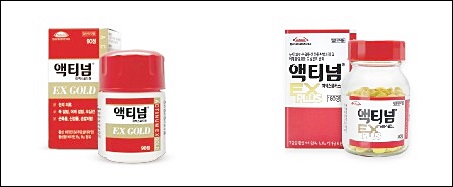
- The Actinum series, once known as Takeda Pharmaceutical's signature mixed vitamin, is experiencing its biggest sales slump in more than seven years since its launch. According to drug distribution performance data, the performance of the Actinium series last year was 2.3 billion won, down 74% from 8.9 billion won in 2018. Between 2018 and 2021, Actinium EX Gold's sales were 4 billion, 2.9 billion, 1.5 billion, and 990 million won, and Actinium EX Gold recorded 4.9 billion, 3.7 billion, 2.1 billion, and 1.2 billion won during the same period. In the first half of 2022, the appearance of the two products was 140 million won and 80 million won, respectively, the worst in the past five years. Actinum, whose main ingredient is Fursultiamine, is once expected to be a blockbuster OTC drug through two lineup of EX Gold and Plus, and is considered the main player in the so-called high-dosage vitamin drug. The inflection point of performance is the aftermath of the boycott of No Japan in 2019 and Takeda, which ended this yearIt is in line with the issue of the transfer rights. It is analyzed that the performance has drawn a gradual downward curve in the indiscriminate boycott of Japanese products, regardless of all industries such as pharmaceuticals, automobiles, and food and beverage. Takeda Pharmaceutical recently transferred its license to Celltrion Pharmaceutical for its OTC Whituben and Albotyl. Actinum is known to have handed over its copyright to Japanese company Alinamin Pharma in 2021. Actinium, which was launched in Korea in 2015, has been sold through cooperative wholesalers such as Geo-Young and Dongwon, and signed an exclusive domestic sales partnership contract with Dong-Wha from April 2019 to January this year. Currently, the authority to import and sell Actinium is in charge of ZP Therapeutics Korea, a commercial business corporation of Zuellig Pharma Korea. The rapid success factor of this product, which was renamed Arinamin in Japan and marketed as Actinum in Korea, lies in its product power. Actinium is a thin-layer sugar tablet and manufacturing method patent, which increases the convenience of taking vitamins with a small size of 9.2mm, and the content and ingredients are stable for four years with a stabilized vitamin product patent. According to Actinium clinical studies, about 80% of patients complaining of eye fatigue, shoulder stiffness, and back pain showed mild or higher symptoms, and at least 3.3 days to up to 5.9 days after starting to take each symptom. In recognition of these efficacy, Actinium EX Plus passed Seoul National University Hospital's Drug Committee (DC) three months after its launch in August 2015, and its product power was recognized. In particular, sufficient data such as clinical data must be available to pass OTC DC at Seoul National University Hospital. In fact, OTC landed at Seoul National University Hospital is only a small number of items such as Ildong's Aronamin and Pfizer's Centrum.
- Policy
- Reimb of Samil·Kukje's rebamipide eye drops adequate
- by Lee, Tak-Sun Dec 13, 2022 06:07am
- Samil Pharmaceutical and Kukje Pharma’s rebamipide eye drop solutions that were developed as a treatment for dry eye were deemed adequate for reimbursement by Korea’s Health Insurance Review and Assessment Service. This is the first achievement made for the drug in 4 months since its approval in June. With the reimbursement adequacy recognized for the drug, its reimbursement listing is expected to come sooner after negotiations with NHIS. HIRA’s Drug Reimbursement Evaluation Committee (DREC) held its 12th annual meeting on the 8th and announced such results. The DREC determined that the reimbursement of Kukje Pharma’s ‘Reba-eye Eye Drops’ and Samil Pharmaceutical’s ‘Reva-K Eye Drops’ are adequate for the treatment of tear functions and ocular surface status in adult patients with dry eye symptoms. Kukje and Samil’s two drugs were approved as incrementally modified drugs by the Ministry of Food and Drug Safety in June. Rebamipide has been previously approved as a treatment for gastric ulcers and gastritis in Korea. However, after its mechanism of action that increases goblet cell density and mucus in the eye were found, Samil Pharmaceutical and Kukje Pharma developed the drug as an eye drop for affected patients. Their drug demonstrated superior efficacy over placebo in a domestic clinical trial in Koreans. Based on such evidence, the MFDS approved them as incrementally modified new drugs, recognizing their improved safety and efficacy. After receiving acknowledgment for its safety and efficacy from the MFDS, HIRA’s DREC acknowledged the adequacy of the drug’s reimbursement during its first deliberation of the drugs. If the agenda passes the drug pricing negotiation step with the NHIS, they will be listed for reimbursement. On the same day, DREC also granted conditional approval for the reimbursement of Janssen Korea’s Erleada Tab (apalutamide).' Erleada's reimbursement adequacy will be accepted if the company accepts the conditions proposed by DREC for the reimbursement.
- Policy
- Big Pharma's sale of Old Drug has increased
- by Lee, Tak-Sun Dec 13, 2022 06:07am
- The number of domestic pharmaceutical companies acquiring domestic copyrights of original drugs has been increasing recently. This is a case in which domestic copyrights have also changed as most original developers sold global copyrights as part of restructuring. Jeil announced on the 8th that it will exclusively supply Bonviva and Bonviva plus, treatments for osteoporosis, in Korea. Bonviva originally entered the domestic market with permission from Roche, a multinational pharmaceutical company. As global copyright was transferred to British pharmaceutical company Aetna Pharma in 2017, domestic copyrights are also changing. Since 2015, Handok has been selling and obtaining permission rights, but it has recently been transferred to Jeil. Pharmanovia, a subsidiary of Aetna Pharm, which has global copyright, signed an exclusive sales contract with Jeil when it established a domestic branch. Currently, Bonvia is licensed by Jeil Pharmaceutical, and Bonviva Plus is registered as a licensed company by Alvogen Korea, a developer. However, reimbursed pharmaceutical companies are still in Korea and Germany. In the future, there is a high possibility that pharmaceutical companies will also be transferred to Jeil through transfer and transfer. SK Chemicals recently acquired domestic copyright for Omnaris nasal spray, an allergic rhinitis treatment. Omnaris nasal spray was introduced and sold by Handok from Nycomed, Switzerland, but domestic copyrights were transferred to Takeda in 2011 and AstraZeneca in 2015. AstraZeneca sold Omnaris' global copyright to Covis Pharma in 2018, and the final destination of domestic copyrights was SK Chemicals. Omnaris was completely transferred to SK Chemicals through transfer and transfer of permission and rights. SK Chemicals also acquired the domestic license for AstraZeneca's asthma treatment Alvesco. LG Chem also acquired the domestic copyright of the anti-inflammatory painkiller Vimovo from AstraZeneca. Vimovo is an NSAIDs-PPI complex released in Korea by AstraZeneca in 2012. LG Chem Participates in Co-promotion Recently, both the right to permit and the right to pay have been transferred. Vimovo's global copyright was also sold to German pharmaceutical company Grünenthal in 2018. Although domestic pharmaceutical companies have acquired exclusive sales rights in Korea beyond co-promotion with overseas pharmaceutical companies, it is too much to lead to a significant increase in profits. This is because it is an old drug that is less competitive than other drugs because it has been released for a long time. Moreover, pharmaceutical companies with global copyrights may terminate their domestic copyright contracts, which cannot be considered completely attributed to assets.
- Policy
- Will SGLT2 combi benefit expansion eventually not happen?
- by Lee, Tak-Sun Dec 12, 2022 05:48am
- #iDiscussions on the expansion of combined benefits between SGLT-2 drugs and other drugs continue to conflict. The government presented a voluntary cut rate to related companies last month to analyze their fiscal impact based on it, which is known to fall short of expectations. As a result, it is expected that it will soon be decided whether to continue the discussion or end it. According to the industry on the 11th, the results of the analysis of the financial impact of the voluntary reduction rate of the upper limit of drugs submitted by 11 diabetes companies to the Ministry of Health and Welfare last month fell short of expectations. The drugs currently under discussion for salary expansion are three-drug therapy such as metformin+SGLT-2+DPP-4, metformin+SGLT-2+TZD, and SGLT-2 +Sulfonylurea or insulin combination therapy. These combination treatments are effective in treating diabetes, so they have continuously demanded pay expansion, focusing on related academic societies. The Ministry of Health and Welfare planned to receive voluntary cuts from companies with these drugs and analyze the financial impact and skip drug price negotiations with the Drug Benefit Evaluation Committee if it meets the expected range and reflect them in the salary through a report by the Health Insurance Policy Review Committee. Otherwise, if the financial increase reflecting the weak cut is greater than expected, it has been delivered to companies through a meeting that it will end discussions on the expansion of combined use. An industry official said, "The voluntary cut rate submitted by companies does not seem to be at the level that the Ministry of Health and Welfare thinks," adding, "If the voluntary cut rate falls below expectations, it is highly likely to end the discussion as announced at the meeting." Since this discussion has been going on for a long time since 2016 through the Diabetes Association, the government will feel burdened to end it immediately. Some analysts say that there is a possibility of receiving another voluntary cut rate. Another official from the pharmaceutical industry said, "So far, we have not notified the company of the results of the financial impact analysis, but I don't think the ait is good," adding, "I think we will discuss ways to cut the weak price once again."
- Company
- “Tagrisso shows effect as 1st-line in the real world"
- by Dec 12, 2022 05:48am
- AstraZeneca’s 3rd generation EGFR mutation-positive non-small cell lung cancer (NSCLC) treatment ‘Tagrisso (osimertinib)’ has shown consistent effects with the clinical trial results in practice. In the real world, Tagrisso demonstrated excellent treatment effects even in patients with brain metastasis, poor systemic condition, or patients with rare mutations. The real-world study results from Germany and Japan that contained the results above were presented at the ESMO Asia 2022 Congress that has been held in Singapore on the 2nd. The large-scale, real-world studies evaluated the use of Tagrisso as a first-line treatment in the field on 600 patients in Japan and 200 patients in Germany. Japan large-scale real-world study results (Source: ESMO) In the Japanese trial that analyzed 583 patients, Tagrisso achieved a median progression-free survival (mPFS) of 20.0 months and median overall survival (mOS) of 4.09 months. By mutation, Tagrisso’s PFS in patients with exon19 deletions reached 23.5 months. In those with L858R mutations, the PFS was 17.0 months. In terms of OS, the OS was 36.1 months in the L858R mutation group, and the median OS was not reached in the exon19 deletion group. German large-scale real-world study results (Source: ESMO) In the German trial that analyzed 217 patients, the time to next treatment or death (TTNTD) and the time to discontinuation (TTD) were measured. Results showed that Tagrisso’s mPFS was 16.2 months, TTNTD 19.2 months, and TTD 14.8 months. In other words, Tagrisso demonstrated an excellent effect not only in patients with brain metastasis that are commonly found in NSCLC but also in patients with rare EGFR mutations. Especially, the rate of patients with brain metastasis accounted for 38% of all patients enrolled in the German real-world study, and 11% were patients with rare mutations that had been excluded from clinical trials. Also, 14% were patients with poor prognosis, the ECOG PS2-3 NSCLC patients. During an interview with Dailyphram, Professor Frank Griesinger of Hemato-Oncology from Germany at Pius-Hospital Medical Campus, University of Oldenburg, said, “Unlike how tests are conducted every 6-8 weeks to evaluate PFS in clinical trials, the PFS in real-world studies tends to be shorter due to longer testing intervals in the field. Tagrisso showed a consistent effect in the real-world study despite the fact that the study enrolled a higher proportion of patients with brain metastasis and rare mutations or poor general conditions, and their age was around 4 years older. Professor Frank Griesinger Professor Griesinger added that over 90% of EGFRm NSCLC patients in Germany choose to use Tagrisso in the first line. He explained that sequential therapy with Tagrisso where other 1st or 2nd-generation treatments are first used followed by 3rd generation drugs may deprive patients of their opportunity to use Tagrisso. Professor Griesinger said, “If you look at the treatment journey of those that undergo sequential treatment, only 70 to 80% of those with advanced disease can receive mutation testing as patients who have already developed resistance often do not have enough tissue left to perform a biopsy. Blood biopsy is somewhat less accurate. Besides, only 38% of Asians are found to receive biomarker testing after developing resistance. Considering how only around half of the few that are tested are T790M-positive, not many patients can use Tagrisso as later line therapies.” He added, “One mistake most people make in the course of making treatment decisions is that the OS data of Tagrisso is good as sequential therapy. But the results have to be better as the data comes from the selected 30% of patients who are eligible to use Tagrisso in the first place. We should not overlook the other 70% of the patients that cannot use Tagrisso in that environment” The OS from the Asian subgroup analysis results for Tagrisso’s Phase III trial has raised controversy. Although Tagrisso showed statistically significant improvement in the entire patient group, the risk ratio (HR) was 0.995 when separately analyzing the Asian patients in the population. An HR of 0.995 means that the difference between Tagrisso and the control group is 0.005, it could be interpreted that there is virtually no difference between Tagrisso and the control group. Regarding Tagrisso’s effect on Asians, Professor Griesinger said “Some parts of the Asian sub-analysis results have been difficult to interpret, but I don't think it's is an issue because the total OS shown demonstrates improvement in the entire population. Tagrisso effect was also consistent in the Japanese real-world study.” Professor Griesinger emphasized, “Based on my practice and research experience Tagrisso is a worthy first-line standard therapy. If the patient has EGFR mutation, there is no reason not to use Tagrisso.”
