- LOGIN
- MemberShip
- 2026-07-23 19:20:20
- Government-Industry clash over price-cut base date
- by Kim, Jin-Gu | translator Alice Kang | 2026-07-23 09:08:43
With the revised drug pricing system set to take effect in just over a month, the base date used to determine the extent of price cuts for already-listed generics has emerged as a key variable.
The government maintains that the 45% pricing rate should be applied based on drug prices at the time the revised system takes effect. The pharmaceutical industry, however, argues that the base should be the prices in place at the time of the across-the-board drug price cuts in 2012, given that prices have since been reduced several times afterwards.
As the difference in the base date could result in additional losses amounting to hundreds of billions of won, industry anxiety is rising.
September 2026 vs April 2012…Disagreement over base date used for pricing rate
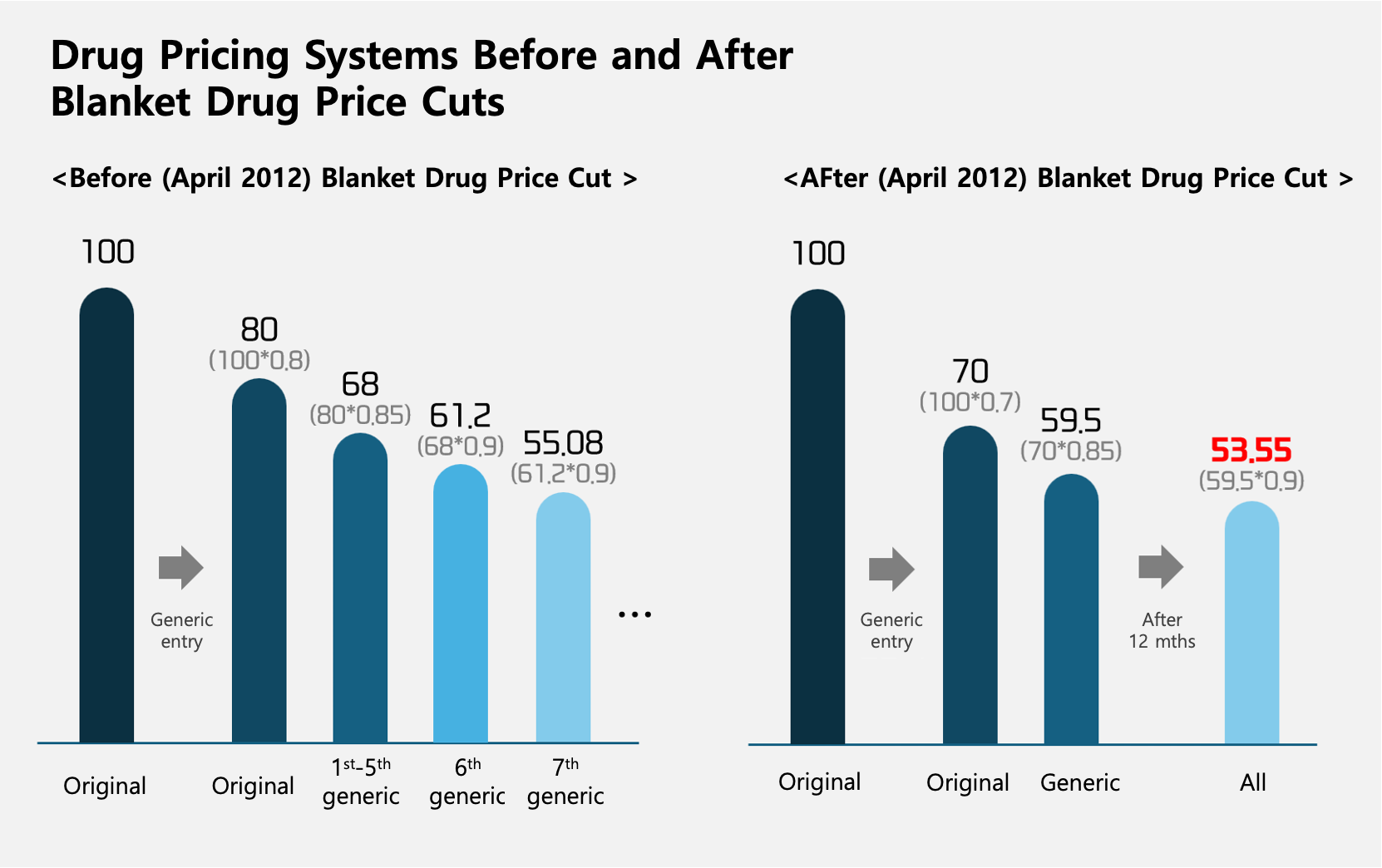
According to the industry sources on July 22, the core of the reform is to lower the generic drug pricing rate from the current 53.55% to 45%. On the surface, this appears to be a reduction of 8.55 percentage points, but the actual size of the cut can vary significantly depending on which point in time is used to determine the original price to which the rate is applied.
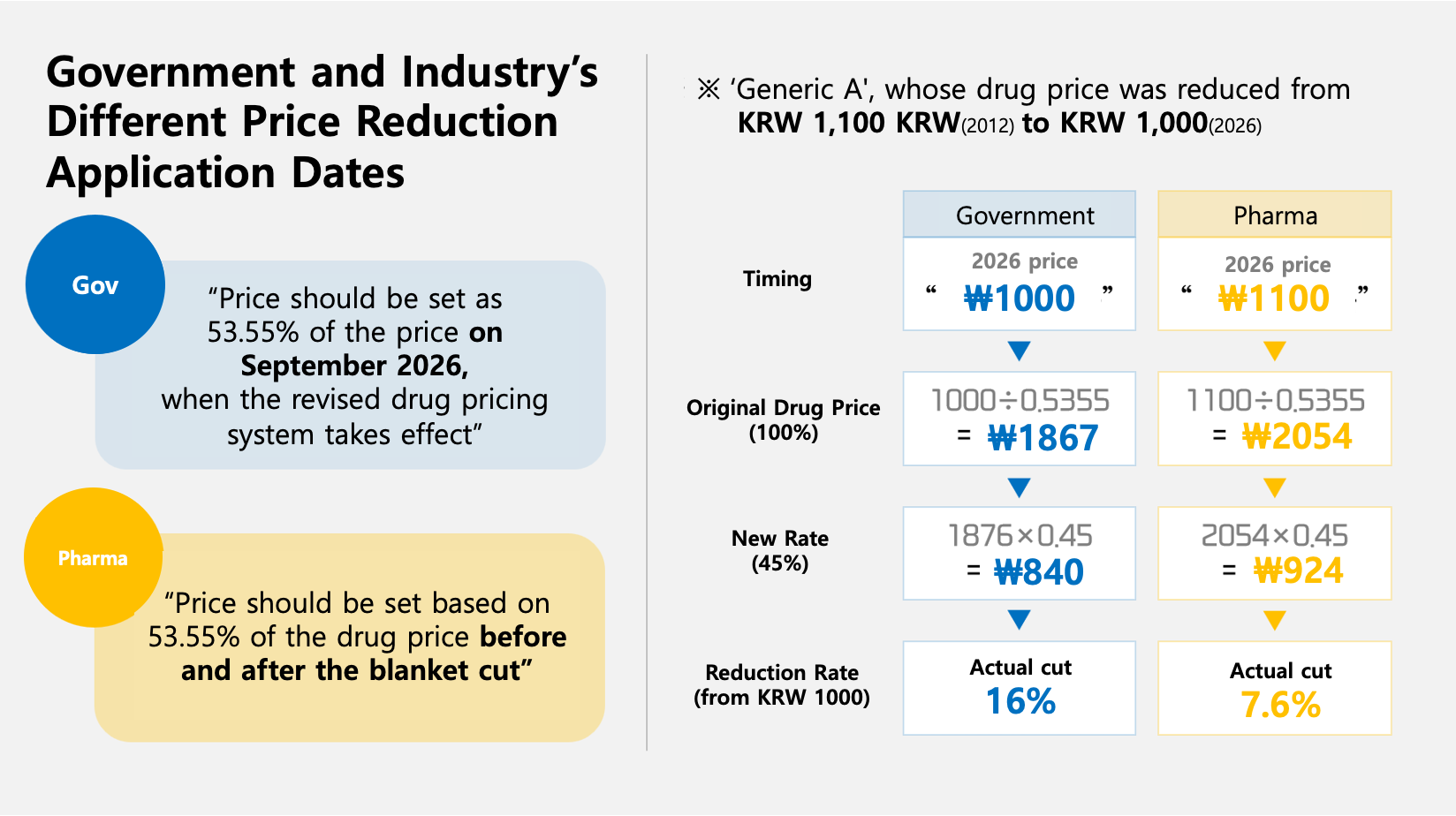
The government plans to regard the price in place at the time of the September 2026 pricing reform as 53.55% of the original drug price and apply the new 45% pricing rate on that
The pharmaceutical industry, by contrast, argues that the base should be the price in April 2012, when the 53.55% standard was first introduced, or in January 2014, when the system had become established. The industry submitted this position during the recent public comment period for the drug pricing reform proposal.
Repeated price cuts made through Price-Volume Agreements and Actual Transaction Pricing…Concerns over “double cuts”
The pharmaceutical industry points out that reimbursed drug prices have continued to decline under the government’s post-listing management measures, including the price-volume agreement system and actual transaction price-based reductions.
It also notes that many products have had their prices cut through generic drug price reevaluations, reimbursement and clinical reevaluations, or voluntary price reductions. The industry therefore argues that using the current point in time (September 2026) as the base amounts to double regulation.
An industry official said, “Drug prices have already been reduced several times under the government’s various post-listing management measures. The government’s proposal would cut these already-lowered prices once again, effectively disregarding previous reductions and imposing regulation twice.”
“The 53.55% rate itself was created in conjunction with the across-the-board drug price cuts in 2012. It would therefore be reasonable to apply the 45% generic pricing rate based on prices at the time of implementation.”
Plavitor price cut 7.5% over 14 Years…may incur an additional KRW 5.7 billion loss depending on the base date
The impact of the base-date difference on projected pharmaceutical sales is clearly illustrated by Samjin Pharmaceutical’s clopidogrel antiplatelet drug ‘Platless.’ Even when the price is reduced to the same 45% level, selecting a different base date results in an additional annual loss of KRW 5.7 billion.
Immediately after the across-the-board price cuts in April 2012, Platless was priced at KRW 1,164 per tablet. Its current price is KRW 1,077, representing a 7.5% decline over 14 years.
Under the government proposal, which uses 2026 as the base, dividing the current price of KRW 1,077 by 0.5355 produces an original drug price equivalent to KRW 2,011. Under the industry proposal, which uses 2012 as the base, the then-price of KRW 1,164 produces an original price of KRW 2,174.
In other words, using the current price, which has already been reduced through mechanisms such as the price-volume agreement system, means beginning with an original-price equivalent that is KRW 163 lower.
Applying the government’s new 45% pricing rate to the converted original price would be 45% of KRW 2,011, resulting in a final price of KRW 905. This is KRW 172 below the current price of KRW 1,077, representing an effective price cut of 16.0%.
Applying 45% to KRW 2,173 under the industry’s proposed method would produce a price of KRW 978. This is KRW 99 below the current price of KRW 1,077, representing an effective reduction of around 9.2%. As a result, using the current price rather than the 2012 price as the base creates a 6.8-percentage-point difference in the effective reduction, at 16.0% versus 9.2%.
Applying these reduction rates to Platless prescription sales last year produces a clear difference in the projected decline in sales.
Under the government method, a 16.0% reduction would result in annual prescription sales losses of KRW 13.4 billion. Under the industry’s requested method, a 9.2% reduction would result in annual losses of around KRW 7.7 billion. A change in the base date alone would therefore cost Samjin Pharmaceutical an additional KRW 5.7 billion in losses annually from a single product.
Additional loss near KRW 27 billion across all clopidogrel products
The difference is not limited to one product. Other clopidogrel generics have undergone almost the same drug price reduction mechanisms as Platless.
The current outpatient prescription market for clopidogrel antiplatelet drugs is estimated at approximately KRW 530 billion. Excluding the original product Plavix (KRW 130 billion), the generic market totals approximately KRW 400 billion.
Applying the difference between the government’s and industry’s reduction rates to the entire clopidogrel generic market produces a gap of KRW 27 billion. Under the government method, total losses across generics would amount to approximately KRW 63.9 billion, compared with KRW 36.7 billion under the industry’s proposed method.
Korea’s generic drug market includes numerous large-volume ingredients with annual sales in the hundreds of billions of won, including valsartan, amlodipine and atorvastatin. If the same calculation is extended across the entire market, the annual loss gap for the domestic pharmaceutical industry could expand into the hundreds of billions of won, depending on which base date is selected.
-

- 0
댓글 운영방식은
댓글은 실명게재와 익명게재 방식이 있으며, 실명은 이름과 아이디가 노출됩니다. 익명은 필명으로 등록 가능하며, 대댓글은 익명으로 등록 가능합니다.
댓글 노출방식은
댓글 명예자문위원(팜-코니언-필기모양 아이콘)으로 위촉된 데일리팜 회원의 댓글은 ‘게시판형 보기’와 ’펼쳐보기형’ 리스트에서 항상 최상단에 노출됩니다. 새로운 댓글을 올리는 일반회원은 ‘게시판형’과 ‘펼쳐보기형’ 모두 팜코니언 회원이 쓴 댓글의 하단에 실시간 노출됩니다.
댓글의 삭제 기준은
다음의 경우 사전 통보없이 삭제하고 아이디 이용정지 또는 영구 가입제한이 될 수도 있습니다.
-
저작권·인격권 등 타인의 권리를 침해하는 경우
상용 프로그램의 등록과 게재, 배포를 안내하는 게시물
타인 또는 제3자의 저작권 및 기타 권리를 침해한 내용을 담은 게시물
-
근거 없는 비방·명예를 훼손하는 게시물
특정 이용자 및 개인에 대한 인신 공격적인 내용의 글 및 직접적인 욕설이 사용된 경우
특정 지역 및 종교간의 감정대립을 조장하는 내용
사실 확인이 안된 소문을 유포 시키는 경우
욕설과 비어, 속어를 담은 내용
정당법 및 공직선거법, 관계 법령에 저촉되는 경우(선관위 요청 시 즉시 삭제)
특정 지역이나 단체를 비하하는 경우
특정인의 명예를 훼손하여 해당인이 삭제를 요청하는 경우
특정인의 개인정보(주민등록번호, 전화, 상세주소 등)를 무단으로 게시하는 경우
타인의 ID 혹은 닉네임을 도용하는 경우
-
게시판 특성상 제한되는 내용
서비스 주제와 맞지 않는 내용의 글을 게재한 경우
동일 내용의 연속 게재 및 여러 기사에 중복 게재한 경우
부분적으로 변경하여 반복 게재하는 경우도 포함
제목과 관련 없는 내용의 게시물, 제목과 본문이 무관한 경우
돈벌기 및 직·간접 상업적 목적의 내용이 포함된 게시물
게시물 읽기 유도 등을 위해 내용과 무관한 제목을 사용한 경우
-
수사기관 등의 공식적인 요청이 있는 경우
-
기타사항
각 서비스의 필요성에 따라 미리 공지한 경우
기타 법률에 저촉되는 정보 게재를 목적으로 할 경우
기타 원만한 운영을 위해 운영자가 필요하다고 판단되는 내용
-
사실 관계 확인 후 삭제
저작권자로부터 허락받지 않은 내용을 무단 게재, 복제, 배포하는 경우
타인의 초상권을 침해하거나 개인정보를 유출하는 경우
당사에 제공한 이용자의 정보가 허위인 경우 (타인의 ID, 비밀번호 도용 등)
※이상의 내용중 일부 사항에 적용될 경우 이용약관 및 관련 법률에 의해 제재를 받으실 수도 있으며, 민·형사상 처벌을 받을 수도 있습니다.
※위에 명시되지 않은 내용이더라도 불법적인 내용으로 판단되거나 데일리팜 서비스에 바람직하지 않다고 판단되는 경우는 선 조치 이후 본 관리 기준을 수정 공시하겠습니다.
※기타 문의 사항은 데일리팜 운영자에게 연락주십시오. 메일 주소는 dailypharm@dailypharm.com입니다.

- Samoh Pharm’s expansion after Voxzogo reimb…orphan drug portfolio
- Reporter's view | Hwang, byoung woo

- “7-year Lorviqua data reshape trt strategy for ALK-positive lung cancer”
- Reporter's view | Son, Hyung Min