- LOGIN
- MemberShip
- 2026-09-13 18:43:19
- Korean companies pursue tailored and muscle-preserving strategies
- by Cha, Ji-Hyun | translator Alice Kang | 2026-05-29 09:14:49
Korean pharmaceutical and biotech companies are steadily producing tangible results in obesity and metabolic disease. Rather than simply chasing Novo Nordisk and Eli Lilly, which dominate the global market, domestic firms are drawing attention with differentiated development strategies ranging from GLP-1 therapies tailored to Koreans to muscle-preserving obesity drugs and histology-improving MASH therapies.
D&D Pharmatech achieves all three key mash biopsy endpoints…positive signal for global partnering
According to the pharmaceutical and biotech industry on the 29th, D&D Pharmatech presented 48-week biopsy results from the U.S. Phase II trial of its MASH candidate “zabopegdutide” (DD01) at the EASL Congress 2026 held in Barcelona, Spain, on the 27th (local time).
In this study, DD01 met all three key efficacy endpoints required for MASH treatment approval. The proportion of patients achieving “MASH resolution without fibrosis progression” reached 62.5%, far exceeding the placebo group’s 5.3%. The proportion achieving “fibrosis improvement without worsening MASH” was 50.0%, outperforming placebo by 34.2 percentage points (placebo: 15.8%). The composite endpoint achieving both criteria simultaneously was also significantly higher at 37.5% versus 5.3% in the placebo group.
DD01 is a dual agonist targeting both the GLP-1 receptor, which promotes insulin secretion and appetite suppression, and the glucagon receptor, which increases energy metabolism. It is being developed as a once-weekly subcutaneous injection. Earlier interim 12-week results already showed that 75.8% of treated patients achieved at least a 30% reduction in fatty liver, meeting the primary endpoint. The latest results also confirmed improvement in actual liver tissue.
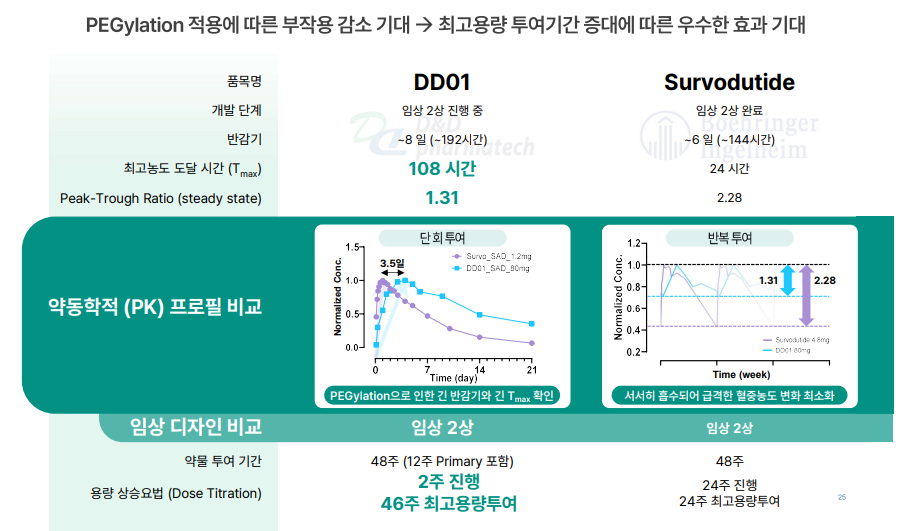
This announcement is considered medically and commercially meaningful because DD01 demonstrated histological evidence of fibrosis improvement rather than merely reducing liver fat. In MASH development, liver fat reduction serves as an early signal of efficacy, but biopsy data showing resolution of steatohepatitis and fibrosis improvement are more important for approval and licensing.
Notably, DD01 reduced intrahepatic fat by 37.0% at Week 12, even among patients with body weight reductions of less than 5%. This has led to interpretations that DD01’s effect may not simply be a secondary effect of weight loss but may also involve direct hepatic metabolic improvement through glucagon receptor stimulation. In obesity drug candidates, a key differentiator for MASH expansion potential is whether the drug itself improves liver metabolism beyond weight reduction, and these results are viewed as evidence supporting DD01’s direct metabolic effect on the liver.
Industry expectations are also rising for a large-scale licensing deal for DD01. Competition among big pharma companies to secure MASH pipelines has intensified globally. Last year, Roche acquired 89bio for up to USD 3.5 billion to obtain the MASH candidate pegozafermin, while Novo Nordisk acquired Akero Therapeutics for up to USD 5.2 billion to secure efruxifermin.
GlaxoSmithKline (GSK) also invested up to USD 2 billion to acquire rights to Boston Pharmaceuticals’ FGF21-based MASH candidate efimosfermin alfa. Efimosfermin alfa failed to achieve statistical significance in the composite endpoint, simultaneously measuring MASH resolution and fibrosis improvement, yet still resulted in a major deal, making it a comparison case that highlights DD01’s asset value.
D&D Pharmatech was co-founded in 2014 by Professor Seulgi Lee of Johns Hopkins University School of Medicine and others. The company develops therapies for obesity, MASH, and neurodegenerative diseases based on GLP-1 peptide technologies. It also possesses ORALINK, a platform for converting injectable drugs into oral formulations, as well as PEGylation technology. In May 2024, the company successfully listed on Korea’s KOSDAQ market through a technology-special listing.
D&D Pharmatech has also attracted market attention after its partner company was acquired by a global big pharma company. In April 2023, D&D signed a technology transfer agreement with U.S. obesity treatment developer Metsera for an oral obesity treatment candidate, establishing a global development partnership. Metsera was later acquired by Pfizer in November last year and became a wholly owned subsidiary, with its obesity pipeline integrated into Pfizer’s portfolio. For D&D Pharmatech, the partnership established with an early-stage biotech effectively became linked to a global big pharma development network.
Beyond DD01, D&D Pharmatech also possesses oral obesity treatment pipelines. Using its ORALINK peptide oral delivery platform, the company is developing oral GLP-1 obesity candidate “DD02S” and oral GLP-1/GIP/glucagon triple agonist candidate “DD03.” DD02S is currently being developed by Metsera as MET-224, and first patient dosing in a North American Phase I/II trial has already been completed. DD03 became part of Pfizer’s portfolio as an oral triple agonist candidate, though its specific development stage has not been disclosed.
Hanmi seeks approval for efpeglenatide…also reveals muscle-increasing novel obesity drug
Hanmi Pharmaceutical recently unveiled its second muscle-increasing obesity drug candidate. The company plans to present 8 research results related to its next-generation obesity candidates ‘HM17321’ and ‘HM500197’ at the American Diabetes Association (ADA 2026) meeting to be held in New Orleans from June 5 to 8.
Newly disclosed HM500197 is a peptide-based candidate that inhibits myostatin. Myostatin is a protein that suppresses muscle growth, and Hanmi believes controlling it could increase muscle mass and improve muscle function. Unlike existing myostatin inhibitors developed mainly as antibodies or Fc fusion proteins, Hanmi designed the candidate as a peptide-based therapy to increase the potential for combination or fixed-dose therapies.
Hanmi is also developing another muscle-increasing obesity candidate, HM17321. Rather than targeting incretin receptors such as GLP-1, HM17321 is a urocortin-2 (UCN2) analog selectively targeting the corticotropin-releasing factor receptor 2 (CRF2 receptor). Hanmi believes HM17321 can simultaneously induce weight loss and muscle gain, addressing the muscle loss limitations often associated with existing GLP-1 obesity therapies.

Hanmi is accelerating new drug development in obesity and metabolic disease. The company has branded its obesity initiative as ‘H.O.P’ (Hanmi Obesity Pipeline) and is rapidly building a customized obesity and metabolic disease portfolio unique to Hanmi. The goal is to establish differentiated obesity drug pipelines using its proprietary long-acting LAPSCOVERY platform and next-generation peptide design capabilities.
Currently, Hanmi Pharmaceutical has established a related obesity and metabolic disease pipeline, which includes HM500197 and HM17321, as well as ▲ the GLP-1 agonist ‘Epfeglenatide’ ▲ , the next-generation triple-action agent ‘HM15275’, which simultaneously targets GLP-1, GIP, and glucagon, and ▲a combination therapy of HM15275 and HM17321.
Among these, efpeglenatide is the most advanced asset in development. Efpeglenatide is a long-acting GLP-1 therapy utilizing Hanmi’s LAPSCOVERY technology and is being developed for both obesity and diabetes indications.
Hanmi is specifically positioning efpeglenatide as a “Korean-style GLP-1 obesity drug” tailored to Korean obesity patients, who generally have a lower prevalence of severe obesity compared with Western populations. In a domestic Phase III trial involving 448 obese adults without diabetes, efpeglenatide achieved an average body weight reduction of 9.8% at week 40, compared with 1.0% in the placebo group. The proportion of patients achieving at least 5% weight loss was 79.4% versus 14.5% in placebo, while rates of at least 10% and 15% weight loss were 46.0% and 19.9%, respectively.
Based on these Phase III results, Hanmi filed a marketing authorization application for Hanmi Efpeglenatide Auto Injector last December with the Ministry of Food and Drug Safety. Last month, it launched the company-wide “EFPE-PROJECT-Seosa” task force to unify development, clinical, manufacturing, and distribution strategies for commercialization. On the 18th, Hanmi also began dosing the first patient in a domestic Phase III trial aimed at expanding indications into diabetes treatment.
The obesity drug war shifts to metabolic disorders and muscle preservation, with Korean latecomers joining the fray
The global market for metabolic disease treatments is rapidly restructuring around GLP-1 agonists, intensifying competition. While Novo Nordisk’s ‘Wegovy’ and Eli Lilly’s ‘Zepbound’ lead the obesity treatment market, competition is expanding beyond single-mechanism GLP-1 agonists to include dual- and triple-action agents that target GIP and glucagon.
Eli Lilly’s triple-action drug ‘Retatrutide’ demonstrated an average weight loss of 28.3% over 80 weeks in Phase III clinical trials, re-emphasizing the direction for next-generation obesity drug development. According to global market research firm Research and Markets, the global obesity treatment market is projected to grow at an average annual rate of 22% from USD 12.8 billion (KRW 18 trillion) last year to reach USD 100 billion (KRW 130 trillion) by 2030.
Against this backdrop, Korean companies are increasingly raising expectations for licensing deals and commercialization by generating concrete clinical results in obesity and metabolic disease. Notably, Korean firms are not simply attempting to imitate leading global products but are differentiating their strategies through Korean-specific GLP-1 therapies, muscle-preserving obesity drugs, histology-improving MASH therapies, oral peptides, and long-acting formulations.
In addition to Hanmi and D&D Pharmatech, pipelines from other domestic latecomers are also drawing attention.
MetaVia, the U.S. subsidiary of Dong-A ST, is developing ‘DA-1726,’ a dual agonist simultaneously targeting GLP-1 and glucagon receptors. MetaVia recently presented additional Phase I data at EASL Congress 2026. In a multiple-dose escalation study conducted in healthy obese adults, the DA-1726 48 mg group showed an average weight loss of 6.1% at Day 26 and 9.1% at Day 54, with waist circumference reductions of 5.8 cm and 9.8 cm, respectively.
No serious adverse events or treatment discontinuations occurred, and no clinically meaningful changes were observed in cardiovascular indicators such as heart rate and QTcF. Non-invasive liver assessments also showed improvements in CAP, VCTE, and FAST scores, suggesting potential applications for obesity-related liver disease and MASH. MetaVia is currently conducting Phase I Part 3 to optimize safety and tolerability at higher doses. The company is also collaborating with ImmunoForge on developing a once-monthly long-acting formulation of DA-1726.
ProGen is also considered one of the major players in the multi-agonist competition. Its candidate “PG-102” is a dual agonist targeting both GLP-1 and GLP-2 receptors. In addition to weight-loss effects through GLP-1, the therapy aims to leverage GLP-2’s role in intestinal mucosal recovery and nutrient absorption to promote healthy weight loss without muscle loss.

Yuhan Corp has also entered the obesity and metabolic disease treatment race. The company has outlined three pillars for its obesity treatment development strategy: ▲ ultra-long-acting injectables ▲ oral synthetic new drugs ▲ next-generation mechanisms. The company states that it has confirmed superior oral bioavailability, as well as greater food intake reduction and weight loss effects compared to competitor drugs in an obese mouse model using its oral GLP-1 receptor agonist candidate ‘YH-GLP-1RA.’ Yuhan Corp aims to begin preclinical studies of this candidate in the third quarter of this year and enter Phase 1 clinical trials by the end of next year.
Formulation technology companies are also moving quickly. As the obesity market shifts beyond simple weight-loss efficacy toward long-term maintenance and dosing convenience, once-monthly long-acting formulations are emerging as a major focus.
Peptron signed a technology evaluation agreement with Eli Lilly in 2024 regarding its drug delivery platform ‘SmartDepot.’ Although the specific target products were not disclosed, the collaboration reportedly involves applying Peptron’s long-acting technology to Lilly’s peptide drugs.
G2GBio plans to present preclinical data at the ADA meeting for one-month sustained-release formulations of CagriSema, tirzepatide, and retatrutide developed using its proprietary “InnoLAMP” platform. Although G2GBio has not directly signed a co-development agreement with Lilly, it aims to demonstrate platform competitiveness by using globally leading obesity candidates as validation models. Meanwhile, Inventage Lab is developing one-month sustained-release injections ‘IVL3021’ based on semaglutide and ‘IVL3024’ based on tirzepatide together with Yuhan.
An industry official explained, “Competition in the obesity drug market is shifting from simple weight-loss rates toward safety, durability, muscle preservation, and improvement of accompanying metabolic diseases. Domestic companies are securing differentiated strengths such as MASH histological improvement and long-acting formulations, so future clinical results and partnering outcomes will be critical.”
-

- 0
댓글 운영방식은
댓글은 실명게재와 익명게재 방식이 있으며, 실명은 이름과 아이디가 노출됩니다. 익명은 필명으로 등록 가능하며, 대댓글은 익명으로 등록 가능합니다.
댓글 노출방식은
댓글 명예자문위원(팜-코니언-필기모양 아이콘)으로 위촉된 데일리팜 회원의 댓글은 ‘게시판형 보기’와 ’펼쳐보기형’ 리스트에서 항상 최상단에 노출됩니다. 새로운 댓글을 올리는 일반회원은 ‘게시판형’과 ‘펼쳐보기형’ 모두 팜코니언 회원이 쓴 댓글의 하단에 실시간 노출됩니다.
댓글의 삭제 기준은
다음의 경우 사전 통보없이 삭제하고 아이디 이용정지 또는 영구 가입제한이 될 수도 있습니다.
-
저작권·인격권 등 타인의 권리를 침해하는 경우
상용 프로그램의 등록과 게재, 배포를 안내하는 게시물
타인 또는 제3자의 저작권 및 기타 권리를 침해한 내용을 담은 게시물
-
근거 없는 비방·명예를 훼손하는 게시물
특정 이용자 및 개인에 대한 인신 공격적인 내용의 글 및 직접적인 욕설이 사용된 경우
특정 지역 및 종교간의 감정대립을 조장하는 내용
사실 확인이 안된 소문을 유포 시키는 경우
욕설과 비어, 속어를 담은 내용
정당법 및 공직선거법, 관계 법령에 저촉되는 경우(선관위 요청 시 즉시 삭제)
특정 지역이나 단체를 비하하는 경우
특정인의 명예를 훼손하여 해당인이 삭제를 요청하는 경우
특정인의 개인정보(주민등록번호, 전화, 상세주소 등)를 무단으로 게시하는 경우
타인의 ID 혹은 닉네임을 도용하는 경우
-
게시판 특성상 제한되는 내용
서비스 주제와 맞지 않는 내용의 글을 게재한 경우
동일 내용의 연속 게재 및 여러 기사에 중복 게재한 경우
부분적으로 변경하여 반복 게재하는 경우도 포함
제목과 관련 없는 내용의 게시물, 제목과 본문이 무관한 경우
돈벌기 및 직·간접 상업적 목적의 내용이 포함된 게시물
게시물 읽기 유도 등을 위해 내용과 무관한 제목을 사용한 경우
-
수사기관 등의 공식적인 요청이 있는 경우
-
기타사항
각 서비스의 필요성에 따라 미리 공지한 경우
기타 법률에 저촉되는 정보 게재를 목적으로 할 경우
기타 원만한 운영을 위해 운영자가 필요하다고 판단되는 내용
-
사실 관계 확인 후 삭제
저작권자로부터 허락받지 않은 내용을 무단 게재, 복제, 배포하는 경우
타인의 초상권을 침해하거나 개인정보를 유출하는 경우
당사에 제공한 이용자의 정보가 허위인 경우 (타인의 ID, 비밀번호 도용 등)
※이상의 내용중 일부 사항에 적용될 경우 이용약관 및 관련 법률에 의해 제재를 받으실 수도 있으며, 민·형사상 처벌을 받을 수도 있습니다.
※위에 명시되지 않은 내용이더라도 불법적인 내용으로 판단되거나 데일리팜 서비스에 바람직하지 않다고 판단되는 경우는 선 조치 이후 본 관리 기준을 수정 공시하겠습니다.
※기타 문의 사항은 데일리팜 운영자에게 연락주십시오. 메일 주소는 dailypharm@dailypharm.com입니다.