- LOGIN
- MemberShip
- 2026-07-27 17:43:46
- Pharma-MOHW disagree on drug pricing policy
- by Lee, Jeong-Hwan | translator | 2026-01-16 08:52:49
The Korean pharmaceutical industry has announced its stance that the government's drug price reform plan, which centers on generic price cuts and preferential pricing for "Innovative Pharmaceutical Companies," is too vague and requires both a delay in implementation and significant revisions.
The industry requested a sufficient grace period, arguing that the plan excludes long-term impact assessments on the pharmaceutical-bio industry and public health, which could lead to industrial contraction.
In contrast, the government stated it has no intention of delaying its plan to submit and finalize the reform at next month's (February) Health Insurance Policy Deliberation Committee for full implementation in July. This has left the gap between the two sides unbridged.
As the pharmaceutical industry and the government have not bridged the divide in opinion, the conflict over drug pricing reform is expected to continue.
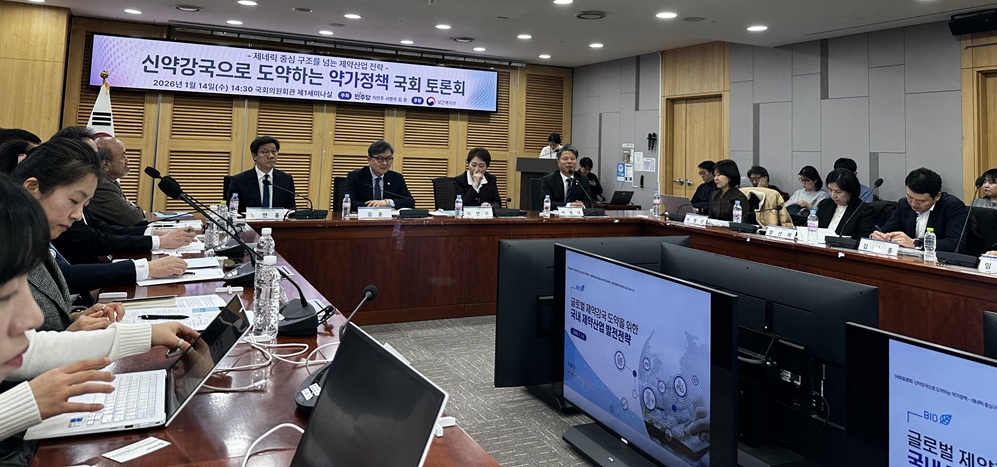
On the 14th, the "National Assembly Forum on Drug Price Policies for Becoming a New Drug Powerhouse," hosted by Democratic Party Representatives Lee Un-ju, Seo Young-seok, and Kim Yoon, brought together the MOHW and industry representatives to exchange views.
Pharmaceutical Industry, "Concerns over job losses, supply instability, and slowed growth"
Hong Jeong-Ki, Managing Director of the Korea Pharmaceutical and Bio-Pharma Manufacturers Association (KPBMA), pointed out that repeated drug price cuts, executed 10 times since 1999, have gradually shrunkne the industry's overall profitability and investment capacity.
Hong also expressed concerns that large-scale cuts to generic prices, as foreshadowed by the MOHW, would inevitably deepen reliance on low-cost imported raw materials and finished imported drugs.
While price cuts might yield short-term fiscal savings, Hong warned that, based on implementation of policies in the past, they could lead to long-term employment shrinkage, instability in the supply of essential medicines, and a slowdown in industrial growth.
Hong argued that the implementation of price cuts should be reconsidered after a comprehensive assessment of the impact on the industry and public health.
Hong argues the need for a sufficient grace period for a successful landing and the establishment of a government-industry governance system.
Furthermore, he requested fair compensation for companies that contribute to innovation and supply stability.
The compensation aims to provide uniform preferential pricing for all Innovative Pharmaceutical Companies and to grant price benefits to non-certified companies that demonstrate excellent R&D performance and facility investment.
"The current reform plan is structured such that damages from strengthened regulations increase while compensation for innovation and supply stability remains limited," Hong pointed out. "This could act as a barrier to becoming one of the world's top five pharmaceutical powerhouses."
He emphasized, "The implementation of drug price cuts must be reconsidered after an assessment of both short- and long-term impacts. We request a sufficient grace period to ensure a soft landing for the system," adding, "It is also necessary to establish a government-industry governance structure for constructive discussions on drug price policy."
He further stressed, "By specifying the innovation-based price addition period and ensuring fair value compensation, we must build a virtuous cycle that accelerates innovation, such as through R&D reinvestment, and leads to the creation of global new drugs," and maintained, "Cuts to the prices of existing listed generics should be minimized to secure investment capacity and ensure supply stability."
"Preferential pricing plan fails to reflect company contribution and diversity"
Kim Sang Jong, Managing Director of Hanmi Pharmaceutical, also criticized the reform, stating it could weaken the foundation for domestic companies to continue investing in new drugs.
Kim argued that cutting existing generic prices without accounting for a company's contribution to new drug R&D creates a structure in which larger companies with higher investment volumes incur greater absolute losses.
In his view, the policy is becoming an overall price cut premised on the notion that Korean generics are expensive compared to overseas markets, rather than a system that guarantees fair returns on investment.
Notably, Kim highlighted that limiting preferential pricing to "Innovative Pharmaceutical Companies" and a few others fails to benefit the many firms that contribute to the industry through Phase 2/3 trial investments, manufacturing facility expansions, quality advancements, and employment of research personnel.
Kim added that extending the price increase period for Innovative Pharmaceutical Companies by three years is only effective in the early stages of the patent-expired market. Once generic market share expands in the later stages, prices drop significantly, making the compensation effect felt by companies very limited.
"The resources needed for new drug R&D, maintaining production facilities for stable supply, and maintaining employment currently come from generic sales," Kim criticized. "It is questionable whether an overall price-cutting policy aligns with reward investment."
Kim further criticized, "The financial resources required for new drug R&D, maintaining production facilities for stable supply, and sustaining employment come from the sales of existing listed generics. For now, this is unavoidable," adding, "While the MOHW stated it would focus on outcomes such as innovation, I question whether implementing a blanket price-cutting policy, based on the idea that high generic prices can now be lowered, actually aligns with the policy goal of rewarding investment."
He added, "It is questionable whether it is truly necessary to further divide preferential drug pricing among Innovative Pharmaceutical Companies into upper and lower tiers. Once the three-year preferential period ends, generic expenditures drop significantly. We are not sure if this can be considered a reward for Innovative Pharmaceutical Companies," adding, "Pharmaceutical companies also need to analyze the reorganization of the drug price system. Since the announcement on November 28 last year, time has been needed to run simulations to determine how to manage operations in line with the policy goals. A grace period (for the drug price cuts) is necessary."
MOHW "Current system has reached its limit... will reform to minimize industry concerns"
Despite such requests from Hong and Kim to delay implementation and revise the preferential pricing policy, the MOHW rejected these requests, stating that the current system has reached its limit and cannot be further delayed.
Kim Yeon-Sook, Head of the Division of Pharmaceutical Benefits at the MOHW, explained, "This reform is being implemented because the current system has reached its limit. It is a structural policy change designed to improve these limits, strengthen the supply stability of both new and essential drugs, and maintain the sustainability of national health insurance," and explained, "Other countries also periodically adjust generic prices while considering fiscal efficiency."
"While our drug price system has previously lacked predictability and fallen short of achieving the goal of generic activation, this reform is different," Kim added. "Unlike past approaches focused solely on reducing drug expenditures, this reform includes mechanism to reward innovation based on investment, even for generics."
Kim concluded, "The government views this reform as a golden time for structural improvement and a leap forward for the industry, centered on Innovative Pharmaceutical Companies. We will implement a drug price system that leads to rewards for the industry to minimize the concerns of domestic pharmaceutical firms."
-

- 0
댓글 운영방식은
댓글은 실명게재와 익명게재 방식이 있으며, 실명은 이름과 아이디가 노출됩니다. 익명은 필명으로 등록 가능하며, 대댓글은 익명으로 등록 가능합니다.
댓글 노출방식은
댓글 명예자문위원(팜-코니언-필기모양 아이콘)으로 위촉된 데일리팜 회원의 댓글은 ‘게시판형 보기’와 ’펼쳐보기형’ 리스트에서 항상 최상단에 노출됩니다. 새로운 댓글을 올리는 일반회원은 ‘게시판형’과 ‘펼쳐보기형’ 모두 팜코니언 회원이 쓴 댓글의 하단에 실시간 노출됩니다.
댓글의 삭제 기준은
다음의 경우 사전 통보없이 삭제하고 아이디 이용정지 또는 영구 가입제한이 될 수도 있습니다.
-
저작권·인격권 등 타인의 권리를 침해하는 경우
상용 프로그램의 등록과 게재, 배포를 안내하는 게시물
타인 또는 제3자의 저작권 및 기타 권리를 침해한 내용을 담은 게시물
-
근거 없는 비방·명예를 훼손하는 게시물
특정 이용자 및 개인에 대한 인신 공격적인 내용의 글 및 직접적인 욕설이 사용된 경우
특정 지역 및 종교간의 감정대립을 조장하는 내용
사실 확인이 안된 소문을 유포 시키는 경우
욕설과 비어, 속어를 담은 내용
정당법 및 공직선거법, 관계 법령에 저촉되는 경우(선관위 요청 시 즉시 삭제)
특정 지역이나 단체를 비하하는 경우
특정인의 명예를 훼손하여 해당인이 삭제를 요청하는 경우
특정인의 개인정보(주민등록번호, 전화, 상세주소 등)를 무단으로 게시하는 경우
타인의 ID 혹은 닉네임을 도용하는 경우
-
게시판 특성상 제한되는 내용
서비스 주제와 맞지 않는 내용의 글을 게재한 경우
동일 내용의 연속 게재 및 여러 기사에 중복 게재한 경우
부분적으로 변경하여 반복 게재하는 경우도 포함
제목과 관련 없는 내용의 게시물, 제목과 본문이 무관한 경우
돈벌기 및 직·간접 상업적 목적의 내용이 포함된 게시물
게시물 읽기 유도 등을 위해 내용과 무관한 제목을 사용한 경우
-
수사기관 등의 공식적인 요청이 있는 경우
-
기타사항
각 서비스의 필요성에 따라 미리 공지한 경우
기타 법률에 저촉되는 정보 게재를 목적으로 할 경우
기타 원만한 운영을 위해 운영자가 필요하다고 판단되는 내용
-
사실 관계 확인 후 삭제
저작권자로부터 허락받지 않은 내용을 무단 게재, 복제, 배포하는 경우
타인의 초상권을 침해하거나 개인정보를 유출하는 경우
당사에 제공한 이용자의 정보가 허위인 경우 (타인의 ID, 비밀번호 도용 등)
※이상의 내용중 일부 사항에 적용될 경우 이용약관 및 관련 법률에 의해 제재를 받으실 수도 있으며, 민·형사상 처벌을 받을 수도 있습니다.
※위에 명시되지 않은 내용이더라도 불법적인 내용으로 판단되거나 데일리팜 서비스에 바람직하지 않다고 판단되는 경우는 선 조치 이후 본 관리 기준을 수정 공시하겠습니다.
※기타 문의 사항은 데일리팜 운영자에게 연락주십시오. 메일 주소는 dailypharm@dailypharm.com입니다.


- Samoh Pharm’s expansion after Voxzogo reimb…orphan drug portfolio
- Reporter's view | Hwang, byoung woo