
- LOGIN
- MemberShip
- 2026-05-02 07:22:57
- Policy
- Vytorin generics suffer blow from reevaluations
- by Lee, Tak-Sun Sep 11, 2023 05:30am
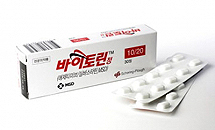
- The hyperlipidemia combination ‘Vytorin (ezetimibe+ simvastatin) suffered a direct blow from the insurance price ceiling reevaluations conducted in Korea. As a result, only two companies were able to maintain the highest insurance ceiling price for their generics. In particular, Genuone Sciences was the only company to maintain the highest ceiling price in the 10/10mg group. According to industry sources, the price ceiling of Vytorin generics had been reduced for 60 of the items (21 10/10mg dosage forms and 28 10/20 dosage forms) as a result of the price ceiling reevaluations. As a result, only Genuone Science’s Vyteb Tab was able to maintain its highest insurance ceiling price at KRW 784 among the 10/10mg dosage forms. Previously, 26 items had been sold at the highest price of KRW 784. In the case of the 10/20mg dosage forms that contain 20mg of simvastatin, the number of highest-priced drugs (KRW 1,095) was reduced to 2 - Genuone Sciences’ Vyteb 10/20mg and Korea United Pharm’s SImpex Duo Tab 10/20mg. Previously, 17 items had been sold at the highest price. The price of the original Vytorin fell from having the highest price due to a price cut made on January 1, 2022. Accordingly, Vytorin tablets 10/10 mg are priced at KRW 781, and 10/20 mg at KRW 1091. The insurance price ceiling set for products whose price was reduced by 15% because it does not meet one of the standard requirements is KRW 666 for the 10/10 mg dose and KRW 931 for the 10/20 mg dose. Of the 35 10/10mg products, 32 were priced lowest at KRW 666, and 28 of the 32 10/20mg products were priced lowest at KRW 931.
- Policy
- Next year's new drug R&D budget: 58 billion won
- by Lee, Jeong-Hwan Sep 08, 2023 05:34am
- The Ministry of Health and Welfare has set the national new drug development (R&D) budget for next year (2024) to 57.99 billion won, an increase of about 16.1 billion won from this year's budget of 41.19 billion won. 10.4 billion won was allocated to research to expand the new drug base, 16.5 billion won to research to build a new drug R&D ecosystem, 8.6 billion won to clinical development of new drugs, and 19.1 billion won to support the development of excellent new drugs to promote global expansion and partnerships. On the 6th, the Ministry of Health and Welfare submitted next year's budget plan to the National Assembly with these contents. National new drug development is a national task of the Yoon Seok-yeol administration. We have set a national scheme to become a global center for bio and digital health and to join the G5 in science and technology by fostering super-gap strategic technologies. The total budget for the project increased compared to the previous year, but most of the items have decreased if you look at the detailed project details. This is due to a decrease in the existing business budget as a new budget for promoting global expansion and partnership worth close to 20 billion won was established. Specifically, 10.465 billion won was earmarked for next year's budget for 'acid drug-based expansion research' to support researchers in deriving active substances and lead substances in order to continuously supply an early-stage new drug pipeline that is qualitatively and quantitatively excellent, compared to this year's 12.76 billion won. This is a decrease of 2.295 billion won compared to 10,000 won. Next year's budget for research on building a new drug R&D ecosystem is also 16.491 billion won, a decrease of 560 million won compared to this year's 17.051 billion won. The goal of the budget is to build an ecosystem that can smoothly connect basic research and clinical research and to intensively foster small and medium-sized enterprises and venture companies. Next year's budget for new drug clinical development has increased. 8.685 billion won was allocated, which is 645 million won more than this year's budget of 8.04 billion won. It is used to support phase 1 and 2 clinical trials for company-centered new drug development and global-level technology transfer. Next year's budget for new drug R&D commercialization support, which supports the resolution of barriers in significant stages of new drug development such as clinical trials, technology commercialization, and manufacturing/production, is 719 million won, a whopping 36.3% decrease from this year's 1.147 billion won. The amount was reduced by 428 million won. Next year's business unit operating expenses are 2.424 billion won, a 10.6% increase from this year's 2.192 billion won. The budget to support the development of excellent new drugs to promote global expansion and partnering, which will be deployed starting next year, is 19.125 billion won. The goal is to intensively foster and support next-generation new drugs that the global pharmaceutical and bio industries are paying attention to. KRW 2.363 billion is spent on lead drugs, 5.437 billion won on candidate drugs, 5.625 billion won on non-clinical trials, and 5.7 billion won on clinical trials. Specifically, the Ministry of Health and Welfare established a new budget to secure differentiated competitiveness and support new drug technologies that can actively advance into the global market. The intention is to strengthen global cooperation to intensively foster and develop next-generation food and new drugs such as ADC, TPD, new targets, and modalities, and to promote five projects that will be successfully carried out. The Ministry of Health and Welfare expects that after 2024, the expected effects will be to expand the domestic new drug development base by deriving excellent effective substances and lead substances, establishing a new drug R&D ecosystem, and enhancing company-centered new drug development capabilities.
- Policy
- Advanced biologics to receive expedited review
- by Lee, Hye-Kyung Sep 08, 2023 05:33am
- Advanced biological drugs that have demonstrated a significant improvement in safety or effect compared to existing treatments will be regarded as ‘drugs with no alternatives’ and allowed to receive expedited review in Korea. Until now, only advanced biopharmaceuticals with limited scope of application (such as patients who have positive or negative biomarkers) compared to existing treatments or those for patients who are unresponsive to existing treatments were regarded as ‘drugs with no alternatives.’ However, the Ministry of Food and Drug Safety decided to expand treatment opportunities for patients with rare and incurable diseases by revising the regulations and allowing expedited processing for biopharmaceuticals that have proven improved safety or efficacy compared to existing treatments. On the 7th, the MFDS issued a pre-announcement of administration of the ‘Partial amendment of the marketing authorization and review regulations for advanced biopharmaceuticals' and announced that it will expand patient treatment opportunities and harmonize domestic and foreign standards and regulations. Article 21 of the regulations that will be amended contains the designation of subjects eligible for fast-track review, which includes cases where there are no alternative treatments. Such cases were defined as ▲ cases where there are no domestically approved drugs, and ▲ cases where the target of application is limited due to the existence of positive or negative biomarkers compared to existing treatments, or cases where existing treatments cannot be used. When targeting patients who could not receive it or were unresponsive, it was limited to cases where there were no alternative treatments. However, through the amendment, the government decided to designate advanced biopharmaceuticals that have proven to have significantly improved safety or effectiveness, as well as drugs where production, import, and supply have been suspended and supply has not been resumed, as those subject to fast track review. In addition, probiotics were included in the definition of biological drugs, and the legal basis for restricting marketing authorization for gene therapies was specified as 'Article 11 (1) 9 (c) and (1) of the Rules on the Safety of Drugs, etc.' Also, terms such as quality review and quality evaluation were unified into standards and test method review, and provisions based on submitted data for conditional approval were also revised. The MFDS is accepting opinion submissions about the pre-announced administrative notice until November 6.
- Policy
- Yooyoung will newly release repackaged flagship Pravafenix
- by Lee, Tak-Sun Sep 07, 2023 03:50pm
- Yooyoung Pharmaceutical has voluntarily withdrawn the marketing authorization for its product, ‘Pravafenix Cap’, as the product is due for a packaging renewal. As a flagship product, Pravefenix Cap has been recording annual sales of approximately 20 billion KRW. The newly self-packaged product is expected to be listed for reimbursement this upcoming October. According to the industry, Yooyoung Pharmaceutical voluntarily withdrew its permit for Pravafenix Cap (pravastatin+fenofibrate) on the 18th. This comes 11 years after the company first received approval in July of 2012. The drug is a treatment for dyslipidemia, imported from the Belgian pharmaceutical company, SMB. Since then, the drug has settled as a flagship item and has long served as Yooyoung's cash cow. Based on UBIST, the drug reached an outpatient prescription sales of 21.4 billion KRW last year. Considering Yooyoung’s total sales being approximately122.1 billion KRW last year, Pravafenix accounted for a high proportion of the company’s total sales. The company received approval for ‘Yooyoung Pravafen Cap’ in February before withdrawing its approval for the existing Pravafenix. In the past, Yooyoung imported Pravafenix from SMB as fully packaged finished goods under an import permit. The new manufacturing approval for Pravafenix allows for the company to import the capsules in bulk and package the products at Yooyoung’s manufacturing facility. The company explained that this decision was made to flexibly respond to market demands. The newly packaged drug is expected to be listed for reimbursement in October. A company official stated that Yooyoung voluntarily withdrew the import permit in order to use the trademark “Pravafenix Cap”, as for the MFDS would not allow two authorizations under identical names. The product name of the new manufactuiring approval has been changed from “Pravafen Cap” to “Pravafenix Cap”. He added, "The newly released Pravafenix Cap is expected to be reimbursed from October, however reimbusment may be claimed for the original Pravafenix Cap as well during a short overlapping period in order to minimize supply interruptions. Although some domestic companies are developing generic versions of Pravafenix, there has been no news of an item receiving marketing authorization yet.
- Policy
- MFDS amends medical device permit renewal regulations
- by Lee, Hye-Kyung Sep 07, 2023 05:31am
- The Ministry of Food and Drug Safety (Minister: Yu-Kyung Oh) issued a pre-announcement of administration on September 6th regarding the amendment of the ‘Regulations on Renewal of Medical Device Manufacturing Permits.’ and will be receiving opinions until September 26th. The amendment contains changes such as requiring different data submissions for each medical device in consideration of each device’s characteristics to ensure the smooth operation of the medical device product renewal system that will be implemented in 2025. The medical device permit renewal system was introduced to periodically check the safety and effectiveness of products that have already been approved, reported, and certified, and requires companies to submit the latest safety and efficacy data, manufacturing and import records, etc. every 5 years to the MFDS. After the MFDS review, companies can continue manufacturing or importing their devices. The main contents of the amendment made are: ▲reasonable application of data submission requirements according to the characteristics of each medical device subject to report production and import discontinuations, etc. ▲focus on maintenance of distributed products during 1st renewal, and full-scale comprehensive review of safety and efficacy during 2nd renewal. For ‘reported products' that are relatively low risk to the human body and medical devices that must submit production/import discontinuation reports because a stable supply of such is necessary for patient safety, companies would need to submit a declaration of conformity as proof that it had reflected the latest standards. Also, ‘maintenance products’ that do not require the application of the latest standards due to discontinuation, companies will only need to submit production/import performance records and safety information measures. In the first renewal period (2025-2029), the government plans to focus on reorganizing the products already in distribution, including reorganizing product names and grades to conform with the current regulations. In the second renewal period (2030-2034), the government plans to reflect the latest standards and comprehensively review the safety and efficacy of medical devices, including safety information actions details made by companies, etc. Also, to increase industry predictability, the renewal application deadline will be clearly defined as 270 to 180 days before the expiration date of the validity period, and specify that safety information and action details that have already been reported (submitted) do not need to be submitted separately. The MFDS had held continuous meetings to listen to opinions in the field on ways to improve the industry's predictability and acceptance of the new system and has actively reviewed the opinions for the amendment. The MFDS said that it expects the new amendment to support the rational operation of the medical device product permit renewal system based on regulatory science and expertise, and stated that it will continue to make efforts to create grounds for the public to use medical devices with greater peace of mind. Opinions submitted during the administrative notice period will be actively reviewed and reflected if necessary. For further information regarding the amendment, please visit the Ministry of Food and Drug Safety’s website (http://mfds.go.kr > Laws/Data > Legislation Data > Legislation/Pre-Announcement of Administration) for review.
- Policy
- What to expect from the upcoming 2-day HIRA DREC meeting
- by Lee, Tak-Sun Sep 07, 2023 05:31am
- The industry’s attention is focused on the Health Insurance Review and Assessment Service’s Drug Reimbursement Evaluation Committee meeting that is being held for an unprecedented 2 days this month. The industry predicts that the 2-day term reflects the difficulty the committee will have in reaching a conclusion on the agendas set for DREC review. In particular, the issues of interest are the reimbursement reevaluation of HA eye drops that have a market size of over KRW 200 billion and the review of reimbursement adequacy of the neurofibromatosis treatment ‘Koselugo Cap’ that was set to receive redeliberations. According to industry sources on the 6th, DREC will hold its 9th meeting on the 6th and then its 10th meeting on the 7th. In other words, the meeting will be held for two days. In the 2-day meeting, the committee members will be deliberating the drug reimbursement adequacy reevaluation results on one day, and the other to deliberate on the decision on long-term care benefits and whether to approve reimbursement for prescription drugs. The industry expects DREC will have difficulty making decisions this time, as the agendas are serious and important to the state and its deliberation requires 2 days. ◆Industry interest rises on whether the use amount of HA eye drops will be restricted In particular, whether the use amount of HA eye drops will be restricted as a result of reimbursement reevaluations remains an issue. The authorities have also been reviewing whether to drop reimbursement for extrinsic diseases, but limiting its usage is the key focus of industry interest. Moreover, the industry is concerned that if the annual limit is set at 4 boxes, their usage will be cut in half. As for the other ingredients subject to reevaluations, their deliberation is expected to proceed without issue as their reimbursement status will not change significantly. According to the industry, it is expected that reimbursement for rebamipide and levosulpiride may be maintained while reimbursement for limaprost alphadex, loxoprofen sodium, and epinastine hydrochloride may be restricted for secondary indications rather than primary indications. ◆Orphan drug Koselugo to be redeliberated for reimbursement, Will Leclaza’s competitor Tagrisso pass deliberations this time? Among newly deliberated drugs, whether Koselugo will pass review is the industry’s primary interest. The committee had decided to rediscuss Koselugo’s reimbursement at the 8th DREC meeting. As it has recently been reported that the HIRA and pharmaceutical companies have reached an agreement on a risk-sharing plan for this drug, attention is being paid to whether it will be able to pass the DREC review this time. Koselugo is the only drug that was judged non-reimbursable by DREC last year. On the 5th, the Korean Organization for Rare Diseases submitted a petition to the Human Rights Commission of the Republic of Korea, calling for coverage of 'Koselugo.’ After its reimbursement was discussed as an agenda item for DREC, patient groups have been strongly calling for its reimbursement. Also, whether the plan to extend reimbursement for Tagrisso to the first line for non-small cell lung cancer, which passed review by the Cancer Disease Review Committee in March, will be reviewed by DREC is receiving attention. The analysis is that if Tagrisso passes the DREC review this time, it could be listed for reimbursement faster than its competitor ‘Leclaza,’, which passed CDDC last month. The results of the DREC meeting will be announced through a press release on the evening of the 7th, the day the 10th meeting is scheduled to end.
- Policy
- Daewoong withdraws its Herceptin biosimilar Ogivri from mkt
- by Lee, Hye-Kyung Sep 06, 2023 05:36am
- Pic of Ogivri sold in the U.S. ‘Ogivri Inj. 150mg (trastuzumab),’ the third Herceptin biosimilar to be approved in Korea, is withdrawing from the Korean market. The Ministry of Food and Drug Safety announced on the 4th that Daewoong Pharmaceutical voluntarily withdrew its license for Ogivri in Korea. Ogivri was developed by the Indian pharmaceutical company Biocon. Alvogen Korea received domestic approval for the product on August 25, 2020, and the license holder was later changed to Daewoong Pharmaceutical. The company received insurance reimbursement for the drug on November 1, 2020, in preparation for releasing Ogivri. However, referring to its non-existent performance for 3 years since its approval and reimbursement, the company suddenly withdrew its reimbursement listing on May 1 and prepared to withdraw from the domestic market. Meanwhile, Sam-oh Pharm had received approval for a same-ingredient drug ‘Tuzepta Inj. 150mg, 440mg,’ which was also supplied by the Ogivri-producer Biocon on July 10th. This was why there were speculations that Daewoong Pharmaceutical may receive a transfer of domestic sales rights for Tuzepta from Samo Pharmaceutical. A Daewoong Pharmaceutical official said, "We decided to withdraw our license for Ogivri due to a change in our company’s global sales strategy. We plan to continue on our biosimilar business in the mid-to long- -term, but are considering conducting our own CDMO business rather than selling other companies' products." Meanwhile, the market share of Roche's original Herceptin, which was approved in Korea in 2005 as a biopharmaceutical for HER2-positive breast cancer and metastatic gastric cancer, has been decreasing since the release of its biosimilars. According to market research institution IQVIA, Herceptin's sales decreased by 25% from KRW 80 billion in 2018 to KRW 60 billion last year. The original's market share decreased from 91% to 63%. On the other hand, the market share of Herceptin biosimilar increased by 28% points in 4 years from 9% in 2018 to 37% last year. Looking at the domestic Herceptin biosimilar approval status, Celltrion received approval for ‘Herzuma’ in November 2014, and Samsung Bioepis obtained approval for ‘Samfenet’ in November 2017. Herzuma’s sales increased 3.7 times in 4 years from KRW 7.7 billion in 2018 to last year. Samfenet’s sales increased 2.5 times in 3 years from KRW 2.2 billion in 2019. Daewoong Pharmaceutical's Ogivri was the 3rd biosimilar to be approved, but the company withdrew its approval after 3 years without launching the product in the market. With the 4th biosimilar also approved in Korea, the production of Herceptin biosimilars continues. Last May, Prestige Biopharma held a preliminary meeting with the European Medicines Agency (EMA) to apply for product approval for its Herceptin biosimilar 'HD201', and in August, Aprogen and Aprogen Healthcare & Games signed an agreement for the joint development of a Herceptin biosimilar, AP063, and completed global Phase 1 clinical trials in the United States.
- Policy
- What about digital therapy devices awaiting approval
- by Lee, Hye-Kyung Sep 06, 2023 05:36am
- Younglim Lee, Head of the Medical Device Review Department In addition to digital treatment devices for improving insomnia, the Ministry of Food and Drug Safety is expecting applications for licenses for digital treatment devices No. 3 and 4 aimed at improving symptoms in the fields of neurology and psychiatry, respiratory rehabilitation, visual disturbances, and tinnitus. Lee Young-rim, head of the medical device review department at the Korea Food and Drug Safety Evaluation Institute, said in a press briefing for a specialized magazine on the 5th, "As of the end of August, there are 47 digital therapeutic devices for which clinical trial plans have been approved," and "among them, confirmatory clinical trials will be conducted in 2021 and 2022." “As there are 14 products for which the trial plan has been approved, it is expected that the application for approval will be made as soon as the clinical trials are completed,” he said. Digital therapeutic devices are software medical devices that provide evidence-based therapeutic intervention to patients to prevent, manage, and treat medical disorders or diseases. Instead of drugs or injections, digital therapeutic devices stimulate organs, tissues, and nerves with electric ultrasounds, etc. to treat diseases. It provides a treatment method different from Electroceutical, which refers to an electronic device that produces a treatment effect. Currently, there are two products approved as digital therapy devices in Korea, DTx/Digital Therapeutics Somzz and WELT-I, which treat insomnia by installing a mobile app on a smartphone after consulting a doctor. Since it has not yet been approved by health insurance, it has not yet been used in clinical settings, and the effectiveness of its actual use information, or performance has not been verified. Director Lee said, “Only when it is used in clinical settings will we be able to hear the opinions of doctors, patients, etc.,” and added, “As it has not yet been used in medical treatment, it appears that time will be needed to collect information or investigate its effects.” Regarding items expected to be approved after the digital treatment device for insomnia, 64% of products approved for confirmatory clinical trials also represent these fields, perhaps because items 1 and 2 are diseases in the neurological and psychiatric fields. Confirmatory clinical plans were approved for rehabilitation (respiratory, orthopedic) 21% and 15% other than neuropsychiatric fields such as generalized anxiety disorder, mild cognitive impairment, alcohol/nicotine disorder, depressive disorder, and eating disorder. Manager Lee said, “As two products have been approved for the treatment of insomnia, many people are waiting for digital treatment devices for various diseases.” He added, “Recruiting patients for clinical trials requires IRB approval, but recruiting patients has been difficult due to COVID-19. “There was an aspect. It is expected that clinical trials will be conducted for many products starting this year.” The expected digital therapy device is one aimed at improving rehabilitation, and clinical trials are underway for a variety of products, including devices for respiratory rehabilitation for elderly patients. He also added that he is conducting various discussions with IT companies called 'Big Tech' to improve regulations on cutting-edge medical products. Director Lee said, “We held on-site consultation meetings with big tech companies such as Naver, Kakao Healthcare, LGU+, KT, and Kakao Brain and identified requirements for regulatory improvement and support.” He added, “Considering the characteristics of generative artificial intelligence medical devices, they are approved as medical devices.” “We decided to prepare licensing and review guidelines that can be used when entering overseas markets and provide consulting and support for licensing, such as clinical trials and verification,” he explained. Regarding Naver, Lunit, Welt, etc. developing ChatGPT in the medical field and examining the possibility of using it for AIMD, Director Lee is working with industry-academic cooperation experts to develop the "Generative AIMD Permission/Examination Guidelines" by November 2024. “We will develop it,” he emphasized, adding, “We are trying to establish screening standards for safety and effectiveness when it is approved as a medical device.”

- Policy
- Reimb of HA eye drops will be restricted in KOR
- by Lee, Tak-Sun Sep 06, 2023 05:36am
- As a result of the government’s reimbursement reevaluations, patients will be unable to receive reimbursement when using hyaluronic acid eye drops for extrinsic diseases, and the amount of their use will also be restricted. The government has also been known to be discussing limiting reimbursement to 4 boxes per year. According to industry sources on the 5th, the Health Insurance Review and Assessment Service is said to have set such a direction regarding the reimbursement of HA eye drops after conducting reevaluations on the adequacy of their reimbursement this year. HA eye drops, rebamipide, limaprost oxiracetam, loxoprofen sodium, levosulpiride, and epinastine hydrochloride were subject to reevaluations on their reimbursement adequacy this year. Among them, the market for the HA eye drops that are used as artificial tears, has the largest market amounting to KRW 200 billion. Industry rumors are that the post-marketing subcommittee, which held a meeting before the Drug Reimbursement Evaluation Committee deliberations set for the 7th of this month, decided to focus on limiting the use amount of the HA eye drops. The plan was to restrict the amount of use to 4 boxes and set a separate reimbursement standard for additional use. In addition, it has been reported that the committee to remove the reimbursement for extrinsic diseases among extrinsic and intrinsic diseases. Currently, HA eye drops are used for intrinsic diseases such as Sjögren's syndrome, mucocutaneous ocular syndrome (Stevens-Johnson syndrome), and dry eye syndrome, as well as extrinsic diseases caused by surgery, drugs, trauma, or contact lens wear. The industry is regarding this as a win as its use for extrinsic diseases is relatively low. The argument that the amount of use of HA eye drops should be limited was raised by the National Evidence-based Healthcare Collaborating Agency in 2020. In the report, 'Post-marketing evaluation of Specialized OTC-ETC Classified Drugs: Focusing on Hyaluronic Acid Eye Drops (Shin Sang-jin)', NECA argued that 12 boxes of disposable eye drops should be set as the amount recognized for reimbursement and that the number of reimbursable prescriptions should be limited to a maximum of 5, like in Australia. However, as many have been arguing that the reimbursement of HA eye drops should be maintained, it remains to be seen whether a clear conclusion will be reached at the DREC meeting on the 7th. HIRA has decided to change its original policy of non-disclosure of the DREC meeting results and release the results through a press release on the same day.
- Policy
- Evaluating Tagrisso's primary benefit
- by Lee, Jeong-Hwan Sep 05, 2023 05:40am
- The Ministry of Health and Welfare announced that it is conducting a cost-effectiveness evaluation regarding the expansion of health insurance coverage for the first-line treatment of AstraZeneca's lung cancer drug Tagrisso. On the 4th, the Ministry of Health and Welfare responded as follows to a written question from People Power Party Rep. Choi Young-hee, a member of the National Assembly Health and Welfare Committee.
